
Published July 1, 2026 · By Roe Baynes · 7 Min Read
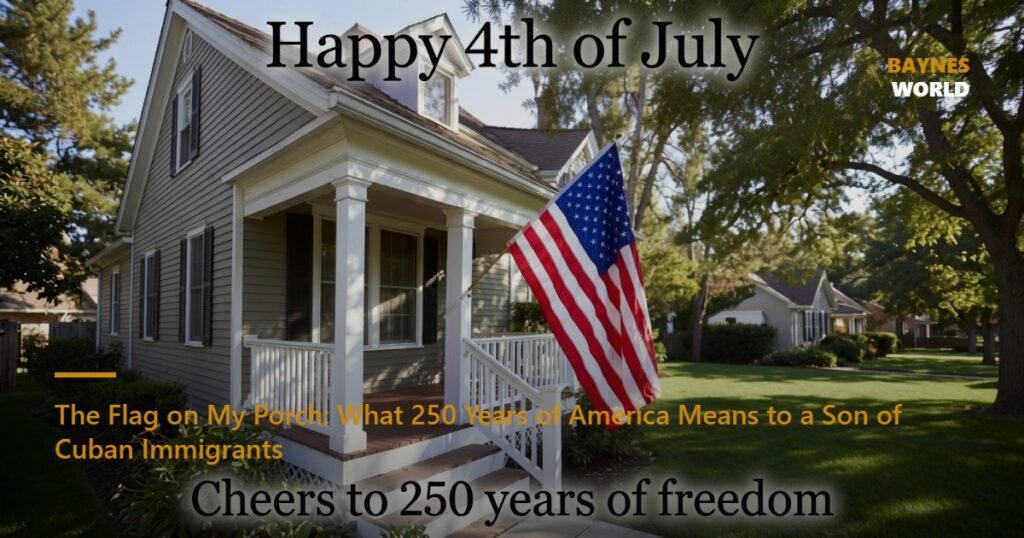
The grill is going before noon. The flag is already up on the porch, the same one that’s hung there for years, snapping a little in the summer wind. Somewhere a speaker is playing salsa, and the smell coming off the grill is a negotiation between burgers and hot dogs on one side and my family’s Cuban cooking on the other — the kind of spread where the kids pile their plates with both and never think twice about it. By the time the sun goes down, those same kids will be running across the yard with sparklers, writing their names in light, while the grown-ups argue happily about which spot has the best view of the fireworks.
That’s the Fourth of July at my house. English and Spanish in the same conversation. The American flag and Cuban culture sharing a backyard without contradiction. It is, if you stop and look at it, the whole American bargain happening over paper plates.
And this year that ordinary backyard scene carries something extraordinary behind it. This Saturday, the United States turns 250 years old.
A flag that meant the wrong thing to a stranger
I want to tell you about that flag on my porch, because a few years ago it got my family called something I never expected.
My wife was standing on our front porch, holding our one-year-old son, the flag flying above them like always. An older woman drove past, slowed down, and shouted that they were Nazis. A mother. A baby. A flag. That was all it took. No conversation, no context — just a stranger looking at the Stars and Stripes above an American family’s home and deciding it stood for hate.
I’ve thought about that moment a lot since. Because to my family, that flag means almost the exact opposite of what she assumed. It means gratitude. It means safety. It means a country that took my people in and gave them something they’d never had before. And somehow, somewhere along the way, that symbol — the one thing that’s supposed to belong to all of us — got sorted onto a team.
It’s worth being honest about how far that’s gone. These days, if you see an American flag flying outside a house, a lot of people will quietly assume something about the owner’s politics. Fly one and you might get read as right-wing. To some, flag-flyers have been smeared as racists, or worse — as my wife learned with a baby on her hip. That’s the loss I want to name, not to score a point on anyone, but because all of us lost something real when our shared flag became a Rorschach test.
And here’s the part both sides need to sit with: the people doing the sorting are the extremes. There’s an extremism on the right I disagree with, and an extremism on the left I disagree with, and between them they’ve convinced a lot of ordinary, decent Americans that a flag is a threat. The overwhelming majority of us — left, right, and everywhere in between — are not the people screaming out of car windows. We’re the ones at the barbecue. The way forward isn’t one side winning. It’s the rest of us meeting in the middle and taking the flag back as common ground.
A country built for the argument
Here’s something we forget when the division feels its worst: this country was built for disagreement.
The founders didn’t design a nation where everyone would agree. They designed one where people could argue — fiercely, publicly, out loud — and settle it without bloodshed. The whole system runs on debate and compromise: take your ideas to the public square, defend them with free speech, and let the best ones rise to the top. That’s not a flaw in the machine. That’s the machine working exactly as intended.
The documents we’re celebrating this week are the proof. The Declaration of Independence put it in writing that we are endowed with rights that no government grants and no government can take: life, liberty, and the pursuit of happiness. The Constitution built the structure to protect them — including the right to stand up and criticize your own government without fear. Those rights are the reason the argument is even possible.
So yes, we are living through one of the most divided stretches this country has ever seen. We’ve gotten so good at fighting that we’ll even fight over how to throw the birthday party — there are, believe it or not, two competing commissions and a squabble over the funding for the 250th itself. But step back and that’s almost reassuring in its own strange way. We have always been a loud, stubborn, arguing people. We were arguing in 1776, and the republic held. It can hold now.
Why my family flies it proudest
If you really want to understand why that flag means what it does to me, you have to understand where my family came from.
They came from communist Cuba. And I don’t mean that as a talking point — I mean it as a fact that shaped everything. In the Cuba they fled, there was no free speech. No private property. No fair trial. If you criticized the government, you could be jailed, no lawyer, no recourse, gone. The rights we list on a sheet of parchment and recite at school — they simply did not exist. (Read our coverage of Raúl Castro and the regime my family escaped.)
My family came here, and they assimilated completely. Not by erasing who they were — we still dance salsa, still cook the food, still speak Spanish at the dinner table — but by becoming fully, genuinely American at the same time. We speak both languages. We celebrate the Fourth like any other American family. And we do it precisely because we know what freedom’s absence feels like.
That’s the thing native-born Americans sometimes have a hard time seeing, and I say this with love: it’s easy to take for granted what you’ve never had to live without. Sometimes it takes not having something to understand what it’s truly worth. The people in my family who lived under a dictatorship don’t have to be reminded what these freedoms are for. They lived the alternative. And so they are, if anything, the most patriotic people I know — first in line to fly the flag, first to tear up at the anthem, first to say out loud how lucky we are.
For all our flaws, still the freest place on earth
People love to call America a racist, xenophobic country. So let me ask the obvious question: if that were true, why does the entire world keep trying to get in?
For all our flaws — and we have them, every nation does — the United States remains the most sought-after destination on the planet. People of every race, every religion, every background risk everything to come here, legally and illegally, in numbers no other country comes close to. You don’t see that kind of demand to enter a place that actually hates outsiders. A truly xenophobic nation isn’t the one the whole world is lining up to join. The proof of what America really is isn’t in the accusation — it’s at the border, in the visa lines, in the millions who’d rather start over here with nothing than stay where they were with everything they knew. They’re voting with their feet. And they’re voting for us.
The party 250 years in the making
This weekend, the celebration stretches from my backyard to the whole country’s — and nowhere bigger than the nation’s capital.
In Washington, the Fourth will bring a “Salute to America” built for the milestone: a major presidential address, a military flyover roaring over the monuments, and what the White House is billing as the largest fireworks display in the world lighting up the sky over the National Mall. The Mall itself will host a “Great American State Fair,” with all fifty states represented in one place — the whole country, shoulder to shoulder, on the lawn between the Washington Monument and the Capitol. It’s the kind of spectacle that only comes around on a birthday this big.
But the capital doesn’t have a monopoly on it. In Philadelphia, where it all started, a national time capsule will be buried for Americans 250 years from now to dig up. In New York Harbor, tall ships and naval vessels from dozens of countries will gather for one of the largest maritime celebrations in modern American history. And fireworks will light up skies in every state, from the big-city spectacles down to the little municipal shows in towns you’ve never heard of.
But strip away the scale and it’s the same thing happening on every front porch. The same flag. The same fireworks. The same families passing the same traditions down to kids who’ll someday pass them to their kids — sparklers and burgers and the national anthem, 250 years on and counting.
Happy 250th, America
We didn’t get everything right at the start. No honest person pretends otherwise. Slavery, exclusion, hard and shameful chapters — they’re real, and they’re ours too. But here’s what we did get right, and it’s the thing worth celebrating: a promise. A promise to keep fighting — generation after generation — for the freedoms of all people, against injustice and against government tyranny. We have spent 250 years slowly, stubbornly, imperfectly making good on that promise, and we’re not done.
So this is my hope for the next 250 years, and for the much nearer future too: that we find our way back to each other. That a Republican and a Democrat can stand on the same street and fly the same flag and understand it means the same thing to both of them — this is the freest country in the world, and we are lucky beyond words to be here. That flag doesn’t belong to a party. It belongs to every American, native-born and naturalized alike, and every one of us should feel free to fly it and proud to.
Happy Fourth of July. Happy 250th birthday, America. Here’s to the freedom we’ve fought for, the freedom we still owe each other, and the next 250 years of the greatest experiment the world has ever seen.
Now if you’ll excuse me — the grill’s ready, the kids found the sparklers, and the flag on my porch has never looked better.
More from Baynes World
Memorial Day: Honoring the Fallen
Father’s Day: Honoring Every Dad