

BREAKING — Published June 30, 2026 · By Roe Baynes · 2.5 Min Read
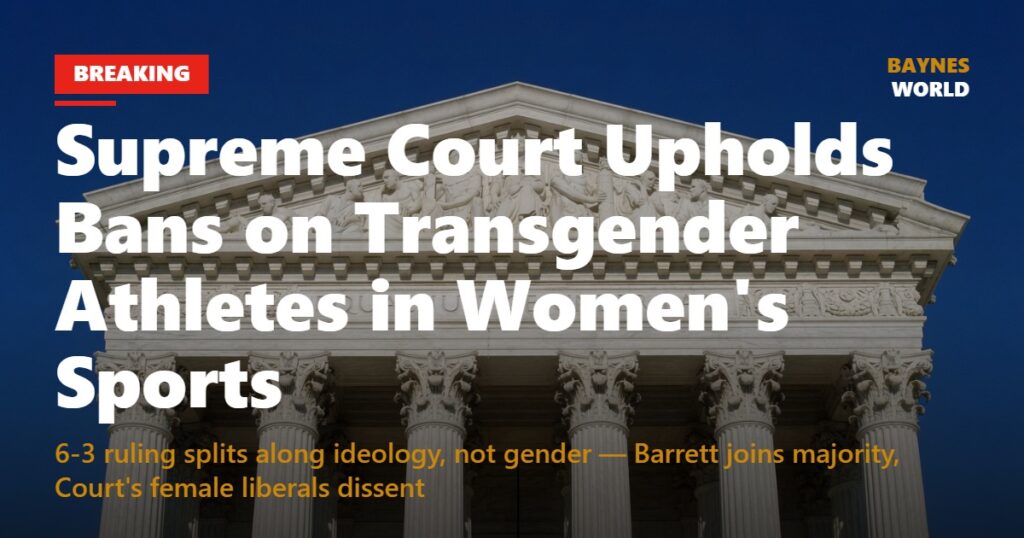
The Supreme Court on Tuesday ruled that states may bar transgender athletes from competing in girls’ and women’s school sports, upholding laws in Idaho and West Virginia in one of the term’s most closely watched culture-war cases. The rulings, West Virginia v. B.P.J. and Little v. Hecox, mark another defeat for transgender-rights plaintiffs at a Court that has sided against them repeatedly in recent years.
The Vote
The Court split 6-3 along ideological lines: Justice Brett Kavanaugh wrote the majority opinion, joined by Chief Justice John Roberts and Justices Clarence Thomas, Samuel Alito, Neil Gorsuch, and Amy Coney Barrett. Justice Sonia Sotomayor wrote the dissent, joined by Justices Elena Kagan and Ketanji Brown Jackson. Notably, the Court was unanimous on a narrower question: even the dissenting justices agreed the state bans don’t violate Title IX, the federal law barring sex discrimination in education. The real fight was over whether the bans violate the Constitution’s Equal Protection Clause — and that’s where the Court divided.
The Majority Opinion
Kavanaugh held that safety and competitive fairness are substantial enough government interests to justify limiting girls’ and women’s teams to biological females, writing that “the Constitution and Title IX do not require an overhaul of women’s and girls’ sports throughout America.” He added that transgender athletes deserve “respect” and should not be “ostracized or vilified” — language several outlets flagged as an unusually conciliatory note in an otherwise decisive loss for trans-rights plaintiffs.
The Dissent
Sotomayor argued the majority went further than necessary, effectively foreclosing transgender athletes from bringing constitutional challenges to these bans at all. She wrote that the Court “inflicts a hardship on those it disfavors” without the “fair and full opportunity” she believes the Constitution requires, and disputed that the record showed a categorical “inherent physical advantage” for transgender athletes across the board.
Ideology, Not Gender, Drew the Line
Worth noting: the split wasn’t male versus female — it was conservative versus liberal. Justice Barrett, a woman, joined the majority upholding the ban. The three dissents came entirely from the Court’s female liberal bloc — Sotomayor, Kagan, and Jackson. On a case framed around protecting women’s sports, the women on the Court didn’t vote as a bloc; ideology predicted the outcome far better than gender did.
Trump’s Reaction
President Trump praised the ruling on Truth Social, calling it a “BIG WIN” and writing that the Court had ruled “AGAINST MEN PLAYING IN WOMEN’S SPORTS.”
What Comes Next
Tuesday’s decision follows last year’s ruling upholding state bans on gender-affirming care for minors, continuing a string of losses for transgender-rights plaintiffs at the Court. More than two dozen states currently have laws similar to Idaho’s and West Virginia’s, and those are now on firm constitutional footing.
Baynes World follows a public Impartiality Pledge on all political coverage.
More from Baynes World
- Supreme Court Strikes Down Trump’s Birthright Citizenship Order
- Supreme Court Upholds Mail-In Ballot Grace Periods (pending permalink)
- Trump v. Slaughter: The Supreme Court Just Rewrote Presidential Power (pending permalink — queued)
- Communism Is the Greatest Threat to America — And I Learned That From My Family