


THE QUICK VERSION — 60 SECOND READ
The Claim: California Governor Gavin Newsom posted on X that “Confederate states are rushing through rigged maps to erase Black districts off the map,” attaching a graphic projecting Republicans gaining 12 seats across the South. The post went viral and sparked widespread “Jim Crow 2.0” comparisons.
The Counter-Claim: Republicans say the redraws are a corrective move — undoing prior race-based, contorted districts and producing maps that better reflect each state’s actual partisan makeup.
What’s True: The geographic pattern is real. Five of the six states that have redrawn maps are former Confederate states. The timing — days after the Supreme Court weakened the Voting Rights Act in Louisiana v. Callais — is not coincidental. Federal courts have repeatedly found intentional racial discrimination in these same states’ maps. On May 26, 2026, a federal court blocked Alabama’s new map specifically for intentionally discriminating against Black voters — the first such ruling on a 2026 map.
What’s Misleading: The viral graphic shows a worst-case scenario that has not happened. Courts are actively blocking the most aggressive redraws. The “Jim Crow 2.0” comparison conflates reducing Black voters’ political influence with preventing them from voting entirely — two different things. Many of the districts being dismantled were themselves originally drawn with race as the predominant factor under federal court order, making them legally vulnerable long before 2026.
Verdict: Partially True but Misleading. Racial gerrymandering is occurring and being found by courts in 2026. The scale and framing being spread on social media is exaggerated and distorts the nature of what is actually happening.
Read the full fact-check below for the complete documented record, court findings, and verdict breakdown.
BREAKING — Updated May 26, 2026
A federal three-judge panel has blocked Alabama’s proposed congressional map, ruling it “intentionally discriminatory” against Black voters — the first federal court to find intentional racial discrimination in a 2026 redistricting action. Alabama’s Attorney General has announced an immediate appeal to the U.S. Supreme Court. This development directly affects the verdict of this fact-check. See the Verdict section below.
This is Part 1 of a four-part series on the 2026 redistricting wars. Part 2: Gerrymandering 101 covers what gerrymandering is and the rules states must follow. Part 3: What’s Actually Happening walks through every state that has redrawn its maps this cycle. Part 4: The Legal Story covers the Voting Rights Act and the court rulings driving everything else.
FACT CHECK: Are Republicans Racially Gerrymandering Confederate States to Bring Back Jim Crow?
By Roe Baynes Published June 8, 2026 · Part 1 of 4 · 9 min read
THE CLAIM
On May 8, 2026 — the same day the Virginia Supreme Court struck down Democrats’ attempt to redraw their state’s congressional map — California Governor Gavin Newsom posted to X:
“Confederate states are rushing through rigged maps to erase Black districts off the map. If this doesn’t make you angry, it should.”
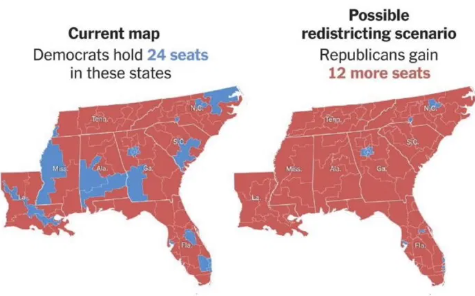
Attached to the post was a two-panel graphic showing the American South. The left panel was labeled “Current map: Democrats hold 24 seats in these states.” The right panel was labeled “Possible redistricting scenario: Republicans gain 12 more seats.” The right-side map showed almost the entire region — from Mississippi through North Carolina and down to Florida — colored solid Republican red, with only a few small blue districts surviving.
The post went viral. Within days it was being copy-pasted verbatim by dozens of other accounts on X, often with no attribution. Cable news ran segments on it. The phrase “Jim Crow 2.0” began trending alongside the broader story.
This fact-check evaluates the claim as it has spread across social media: that Republicans are racially gerrymandering in Southern states in 2026 in an effort to erase Black districts and bring the country back into a Jim Crow-style era.
THE COUNTER-CLAIM
The most common Republican response is that the 2026 redistricting is not race-based at all — that it is a corrective move to undo prior race-based redistricting, which used contorted district shapes to artificially boost Democratic representation. The argument runs roughly like this: federal courts in the 1990s and 2000s ordered Southern states to draw majority-Black districts to comply with the Voting Rights Act. Many of those districts were drawn in unusual shapes that violated traditional redistricting rules like compactness and respect for community boundaries. The Supreme Court’s April 29, 2026 ruling in Louisiana v. Callais clarified that race cannot be the predominant factor in drawing districts. Southern states, the argument goes, are now redrawing maps that are less race-conscious, more compact, and more aligned with how their voters actually vote — Republican states should have predominantly Republican delegations.
A commenter sharing a Newsbusters article on X summarized this view bluntly: “The redistricting of states is a corrective move to right the wrong done by Obama and his party. Not a racial thing but a realistic take of fair voting.”
WHAT’S ACTUALLY HAPPENING: THE DOCUMENTED RECORD
Before evaluating either claim, here is what is documented and undisputed as of late May 2026:
Tennessee (May 7, 2026): Eight days after Louisiana v. Callais, Tennessee’s legislature dismantled the 9th District — the state’s only majority-Black district — splitting Memphis among three Republican-leaning districts that stretch hundreds of miles east. A federal lawsuit was filed by Rep. Steve Cohen and the NAACP on May 8.
Louisiana (May 14, 2026): The state Senate passed a new map eliminating one of two majority-Black districts. Republican Governor Jeff Landry suspended the May 2 congressional primaries to create time for redistricting, voiding more than 42,000 already-cast ballots. The map is awaiting final passage and signing.
Texas (August 29, 2025): Adopted a mid-decade map projected to add five Republican seats. A federal court in El Paso struck it down as a racial gerrymander in November 2025. The U.S. Supreme Court stayed that ruling, allowing the map to remain in effect for the 2026 elections while litigation continues.
North Carolina (October 22, 2025): New map projected to shift the congressional delegation from 10-4 Republican to 11-3 Republican.
Missouri (September 28, 2025): New map dismantling the Kansas City-area Democratic 5th District. Upheld by the Missouri Supreme Court on March 24, 2026.
Alabama (May 2026, blocked May 26, 2026): Republican legislators passed a new map designed to produce a 6-1 Republican delegation, eliminating one of two majority-Black districts. A federal three-judge panel blocked it on May 26, ruling it “intentionally discriminatory” against Black voters and ordering the state to keep using the court-drawn Special Master map from 2024. Alabama’s Attorney General has announced an immediate appeal to the U.S. Supreme Court.
Of these six states, five have been subject to repeated federal court findings of intentional racial discrimination in their maps over the past decade. The Alabama ruling issued today is the most direct evidence yet that the pattern of racial targeting is real and judicially documented in the 2026 cycle specifically — not just in prior years
WHERE THE CLAIM HAS MERIT
Several elements of the racial-gerrymandering claim are supported by the documented record:
- The states doing this are concentrated in the former Confederacy. Of the states that have completed or attempted mid-decade redistricting to Republican advantage in 2025-26, the majority — Texas, Louisiana, Tennessee, North Carolina, Alabama, and pending action in Florida — are former Confederate states. The geographic pattern is real and not random.
- The timing is not coincidental. Louisiana v. Callais came down on April 29. Within nine days, Tennessee had dismantled its only majority-Black district. Within sixteen days, Louisiana had passed a Senate map eliminating one of its two majority-Black districts. Alabama followed within weeks. Multiple Republican-controlled Southern states moved the moment the legal constraints loosened.
- Federal courts have repeatedly found intentional racial discrimination — including today. This is the strongest piece of evidence for the claim. In the past decade, federal courts have struck down maps in Alabama, Louisiana, North Carolina, South Carolina, and Texas as either racial gerrymanders or Voting Rights Act violations. Today’s Alabama ruling found the 2026 map “intentionally discriminatory” against Black voters — a judicial finding, not a partisan accusation. The November 2025 federal court ruling on Texas’s mid-decade map found that Hispanic communities in the Rio Grande Valley were cracked across multiple districts in a way that constituted illegal racial discrimination.
- The practical effect is documented vote dilution. Whatever the stated intent of the mapmakers, the effect of dismantling majority-Black districts is that Black voters become a minority in districts where they previously formed a majority, reducing their ability to elect candidates of their choice. This is the textbook definition of vote dilution under the Voting Rights Act.
WHERE THE CLAIM IS MISLEADING
Several elements of the claim, as it has spread across social media, do not survive scrutiny:
- The graphic Newsom shared is a worst-case projection, not what is actually happening. The “12 more seats” figure represents what could happen if every Southern state went all-in on redistricting at the maximum politically possible level. That is not what has occurred. As of late May 2026, Republicans have netted roughly 8-10 seats across the entire country from the cycle’s redistricting, offset somewhat by California’s Prop 50 adding 5 Democratic seats. Courts have also blocked several attempted Republican redraws — including Alabama’s today. Using a worst-case projection as if it were current reality is a fear-mongering technique designed to make readers angry about something that has not fully happened and may not happen.
- “Jim Crow 2.0” collapses an important distinction. Jim Crow was a comprehensive system of legal segregation that included poll taxes, literacy tests, white-only primaries, grandfather clauses, and state-sanctioned violence designed to prevent Black citizens from voting at all. Modern redistricting reduces the political power of Black voters’ votes but does not prevent them from casting ballots. The harm is real, but it is not the same harm. Equating the two trivializes what Jim Crow actually was and risks numbing people to the genuine injustice that system represented.
- Many of the districts being dismantled were themselves race-based by design. Many of the majority-Black districts being dismantled in 2026 were originally drawn under federal court orders specifically because they grouped Black voters together by race — using race as the predominant factor in their construction. This is what made them comply with the Voting Rights Act, but it is also what made them legally vulnerable under Shaw v. Reno (1993) and now Louisiana v. Callais. Louisiana’s prior majority-Black district, for example, stretched from Shreveport to Baton Rouge in a thin, contorted shape specifically to capture Black population centers. The new maps replacing them are, in many cases, more compact and follow more conventional geographic boundaries. A map drawn specifically around race being replaced by a more geographically conventional map is not the same as racial erasure — even if the political effect disadvantages Black voters.
- Republican states are drawing maps closer to their actual vote share. Louisiana, Tennessee, Texas, and North Carolina are deeply Republican states. Louisiana has voted Republican in every presidential election since 2000; Trump won it by 22 points in 2024. Trump won Tennessee by 30 points. Under the old maps, Democrats held seats in these states largely because federal courts had ordered the creation of majority-Black districts. Producing delegations closer to the statewide partisan balance is not, in itself, evidence of racial discrimination — though it can coexist with it, and courts will decide where the line falls.
- The originator of the claim has his own redistricting record to answer for. Newsom championed California’s Proposition 50, approved by voters in November 2025, which suspended the state’s independent redistricting commission for three election cycles to allow Democrats to draw a map adding up to five Democratic seats — explicitly framed as retaliation against Texas. Newsom’s argument that mid-decade partisan redistricting is “rigging” elections applies equally to what California did under his leadership. This does not disprove his claim about Southern states, but it significantly undercuts his standing to make it.
WHAT BOTH SIDES GET WRONG
The most honest framing of the 2026 redistricting fight requires acknowledging two things simultaneously, which neither side is doing:
The left’s framing is too apocalyptic. Calling Republican states “Confederate states” engaged in “Jim Crow 2.0” overstates what is happening. Courts have blocked several of the most aggressive attempts, including Alabama’s today. The graphic Newsom shared depicts a hypothetical worst-case scenario, not current reality. The claim that this is identical to Jim Crow trivializes history and muddies the legitimate legal arguments being made in federal court right now.
The right’s framing is too innocent. Calling the 2026 redraws “corrective” and “not a racial thing” ignores that federal courts have repeatedly — including today in Alabama — found that Republican-drawn Southern maps intentionally discriminate against Black voters. It ignores that the timing of the 2026 redraws, within days of Louisiana v. Callais loosening the legal constraints, strongly suggests the strategy was waiting for legal cover rather than being driven by neutral principles of fair representation. And it ignores that drawing maps closer to vote share could have been achieved through neutral redistricting commissions rather than partisan legislatures rushing maps through in three-day special sessions.
THE VERDICT: PARTIALLY TRUE BUT MISLEADING
The claim that Republicans are racially gerrymandering Southern states in 2026 is supported in pattern. The geographic concentration in former Confederate states is real. The timing relative to Louisiana v. Callais is not coincidental. Federal courts have repeatedly found racial discrimination in maps from these same states — and as of today, May 26, 2026, a federal court has found intentional racial discrimination in a specifically 2026 redistricting action in Alabama. The practical effect of the new maps is to reduce Black voters’ political power.
But the claim, as it has spread across social media, is misleading in three important ways.
First, the viral graphic depicts a hypothetical worst-case scenario — 12 Republican seat gains across the South — as if it were current reality. It is not. Courts have blocked multiple attempts, seats have not been erased at the scale implied, and the redistricting fight is actively being contested in federal court with mixed results for Republicans.
Second, the “Jim Crow 2.0” framing equates vote dilution with vote prevention and trivializes what Jim Crow actually was. Reducing a community’s political influence and systematically preventing that community from voting at all are different things, even when both are unjust.
Third, many of the districts being dismantled were themselves drawn with race as the predominant factor — under federal court order — to comply with the Voting Rights Act. Those districts were legally and constitutionally vulnerable long before 2026. Replacing them with more geographically conventional maps, even when the political effect disadvantages Black voters, is a legally distinct action from the kind of racial targeting Jim Crow represented.
Update as of May 26, 2026: A federal court today found intentional racial discrimination in Alabama’s 2026 redistricting map — the first such judicial finding specific to a 2026 action. This strengthens the “partially true” portion of the verdict and shifts the factual picture. The claim that racial gerrymandering is occurring in 2026 now has direct judicial support, not just historical pattern evidence. The “misleading” portion of the verdict stands because the scale implied by the viral graphic and the Jim Crow framing remain inaccurate. Both things are true: racial gerrymandering is occurring in 2026 and is being found by courts, and the claim as framed on social media exaggerates and distorts the nature and scale of what is happening.
The most accurate summary: post-Louisiana v. Callais, Republican-controlled Southern states moved quickly to dismantle majority-minority congressional districts, doing so for a combination of partisan and racial reasons. Courts are actively pushing back. Some maps have been blocked. Others remain in force pending appeal. The fight is ongoing, the outcome is not settled, and anyone telling you it is — in either direction — is not giving you the full picture.
Further update, June 3, 2026: The U.S. Supreme Court reversed course on Alabama, overruling the May 26 federal court decision that had blocked the state’s new map. In a late-night order joined by all six conservative justices, the Court allowed Alabama to use its 2023 congressional map — a map a federal district court had explicitly found to be “intentionally discriminatory” against Black voters — for the August 2026 primary. Justice Sotomayor dissented sharply, noting the ruling disrupted voting already underway. Legal experts and civil rights organizations called it a second blow to the Voting Rights Act in five weeks, with Democracy Docket writing that the ruling signals “almost no federal protections remain for non-white voters, even in extreme cases.” This development further strengthens the “partially true” portion of this fact-check’s verdict: racial gerrymandering is now not only occurring and being documented by courts, but is being permitted by the Supreme Court despite those findings. The “misleading” portion of the verdict stands on the Jim Crow framing and the scale implied by the viral graphic — but the factual core of the original claim has grown harder to dismiss.
That is not a Jim Crow 2.0. It is also not a neutral correction. It is what is actually happening.
Continue to Part 2: Gerrymandering 101 — What It Is, Why States Redistrict, and the 8 Rules →
Sources
Gavin Newsom on X, May 8, 2026; widely reproduced across Daily Kos, Townhall, Daily Caller, RedState.
Newsbusters/CNSNews, “Democrat Voters Support ‘Retaliatory’ Gerrymandering,” Craig Bannister, May 19, 2026.
Louisiana v. Callais, No. 24-109 (U.S. Apr. 29, 2026).
Alabama redistricting ruling, May 26, 2026: Roll Call (Michael Macagnone); NBC News; CNN; Washington Post (AP/Kim Chandler and David A. Lieb); WLOS News.
Tennessee redistricting, May 7, 2026: NBC News, CNN, Roll Call, Tennessee Lookout, The Intercept.
Louisiana redistricting, May 14, 2026: Roll Call, NBC News, PBS NewsHour, Louisiana Illuminator, Democracy Docket, Verite News.
Texas 2025 map and November 2025 federal court ruling: NBC News, Texas Tribune, Brennan Center for Justice.
North Carolina, October 2025: WHQR, New York Times, WRAL News.
Missouri, September 2025 and March 2026 ruling: Associated Press, Washington Examiner.
Federal court findings of intentional racial discrimination in Southern maps over the past decade: Brennan Center for Justice; NAACP Legal Defense Fund.
California Proposition 50, November 2025: CalMatters, Public Policy Institute of California, Daily Caller.
Polling on retaliatory gerrymandering: The Economist/YouGov, May 9-11, 2026; POLITICO/UC Berkeley Citrin Center; Rasmussen Reports.