

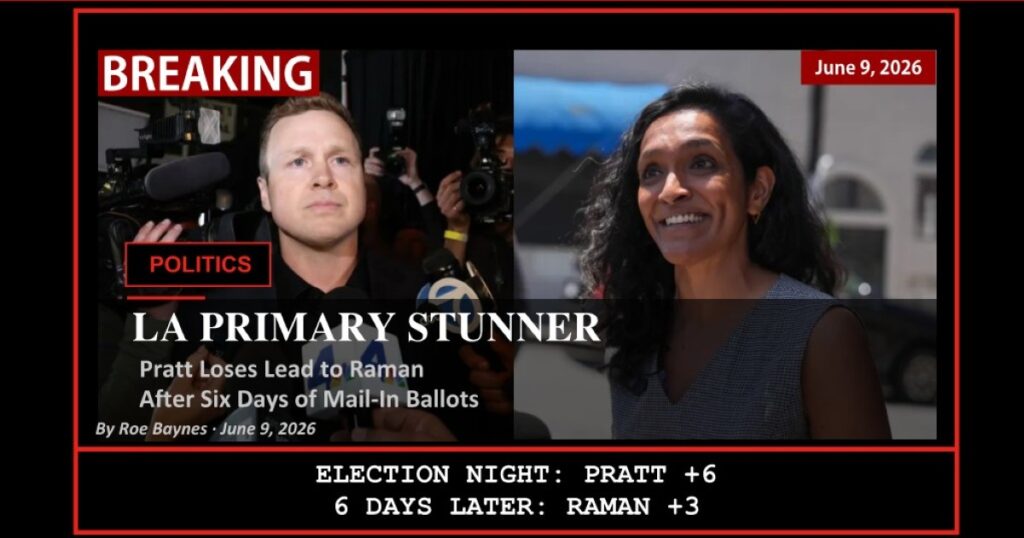
BREAKING — Published June 9, 2026 · By Roe Baynes · 5 Min Read
For our complete coverage of the 2026 elections and California’s broader political landscape visit baynesworld.com
On election night last Tuesday, June 2, former reality television star Spencer Pratt walked into his Election Day party in Los Angeles surrounded by supporters and media. With nearly half the expected vote counted Pratt was sitting at 29% — comfortably in second place behind incumbent Mayor Karen Bass at 35%, and well ahead of Los Angeles City Councilwoman Nithya Raman in third at 23%. As the night wore on his lead grew. By the end of Wednesday with 66% of the vote counted Pratt was at 29%, Raman at 23% — a six-point gap that appeared insurmountable barring an unusual late shift.
Six days later that gap has not just closed. It has reversed completely. The Associated Press has now projected Nithya Raman the winner of the second runoff spot, advancing alongside Karen Bass to the November 3 general election. Spencer Pratt — who was the projected second-place finisher on election night — is no longer in the race.
The vote totals tell the story in a single line. From Tuesday night through Monday, Pratt’s percentage of the vote dropped from 29% down to 26%. Raman’s percentage climbed from 23% up to 29% and ultimately past Pratt. By Monday’s updated count Bass remained at 34%, Raman had risen to 29%, and Pratt was sitting at 26%. Approximately 21,800 votes separate Raman from Pratt with 93% of the expected vote counted.
How the Lead Disappeared
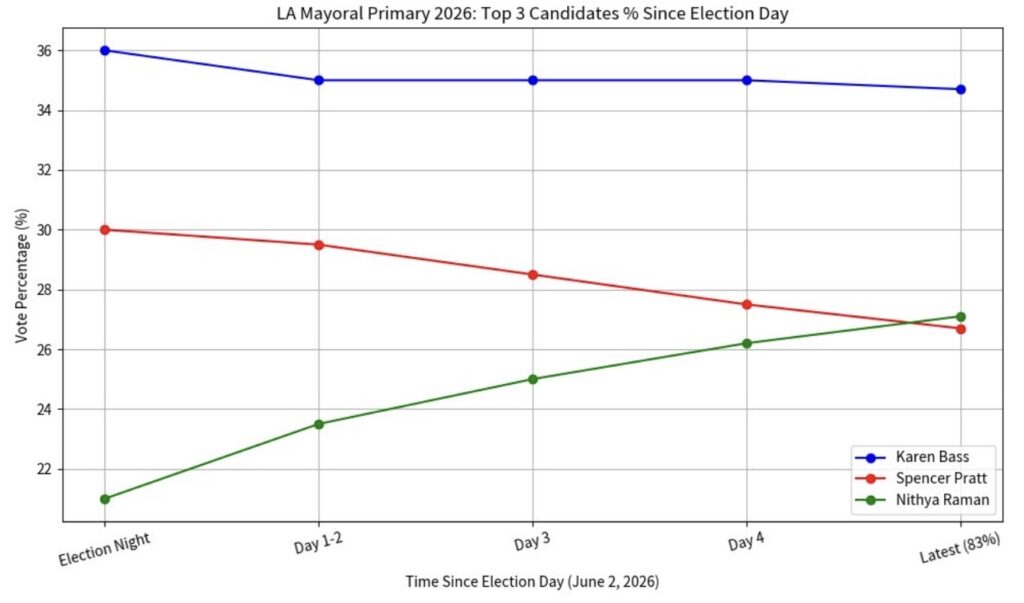
The mechanics of what happened are straightforward — and entirely legal under California law. California allows county election officials up to 30 days to complete the official canvass and process all eligible ballots. Mail-in ballots postmarked by election day continue to arrive for up to a week after, and provisional ballots and conditional registration ballots require additional verification time. As the days passed and additional mail-in and provisional ballots were processed, the partisan and ideological composition of those late ballots favored Raman significantly more than they favored Pratt.
California Secretary of State Shirley Weber addressed the timeline directly in a statement: “Accuracy comes before speed. California is the nation’s largest voting state, with millions of ballots to process and count. Taking the time to do this work correctly protects voters’ rights and ensures the integrity of our elections.”
That is the official position. It is also, mechanically, accurate. California does allow this. The system was designed this way. And the same dynamic — slow vote counts where late ballots break heavily toward Democratic and progressive candidates — has played out in California race after California race for years.
The question many Republicans and reform advocates are now asking is whether the system being legal makes it acceptable.
The Republican Response
President Trump and Republican leaders have been raising serious questions about California’s election administration in the wake of the result. The pattern is now familiar enough that even casual political observers have noticed it — Republicans tend to lead California races on election night, and then over the following days as mail-in ballots are counted those leads systematically shrink and frequently reverse entirely.
The Republican critique rests on three core points:
One-day voting works. States like Florida — the third most populous state in the country with more than 22 million residents — routinely count their entire vote on election night and produce final results by the next morning. Florida processes early voting and mail-in ballots before election day and reports them as soon as polls close. The official Florida result is typically known by midnight the same night. If a state with 22 million residents can do it, the argument goes, California with 39 million residents certainly can.
The pattern always breaks one direction. When mail-in ballot counts consistently move results toward one party over six or seven days following an election, that is not random statistical noise. There is either a systemic bias in who uses mail-in voting versus who votes in person — a real and documented phenomenon that favors Democrats in California — or there is something more concerning happening in how those ballots are processed and verified. Either way the result is the same: Republican leads from election night routinely evaporate.
The lack of verification raises legitimate concerns. California’s mail-in ballot system relies primarily on signature matching for verification. Election officials compare the signature on the returned ballot envelope to the signature on file from the voter registration. Critics argue this system is far less rigorous than the photo ID requirements that the SAVE America Act would have imposed — and which 81% of Americans support according to recent polling.
Trump himself has repeatedly criticized California’s election administration on Truth Social over the past year, using the LA mayoral count as another example of what he calls election integrity failures in the state. The pattern: Republicans win on election night, Democrats win after the count.
The Counterargument
The Democratic response to these critiques generally rests on three points of their own:
Counting takes time and that is by design. California’s larger population, more permissive voting laws, and high mail-in ballot participation create more ballots to process. Doing that work correctly is more important than doing it quickly. The slow count is not evidence of fraud — it is evidence of due diligence.
Mail-in voters skew Democratic for demographic reasons. Working-class voters, college-educated professionals, and younger voters disproportionately use mail-in voting in California. Those demographics also lean Democratic. The result that late ballots favor Democrats is not suspicious — it is statistically predictable based on who uses the mail-in system.
There is no evidence of widespread fraud. Independent audits of California elections have not found systematic fraud at scale large enough to flip results. The Pratt-to-Raman shift is dramatic but it falls within the range of normal late-ballot patterns observed in California elections for the past decade.
Whether one finds the Democratic explanation persuasive depends largely on one’s prior view of California’s election administration. The data is the data. The interpretation is contested.
What Happens Next
Nithya Raman will face incumbent Mayor Karen Bass in the November 3 general election. The two were once political allies — Bass campaigned for Raman in her 2024 city council reelection. Raman launched her mayoral challenge in February 2026 just hours before the filing deadline, having reportedly informed Bass personally before announcing publicly. The race is now between two Democrats but covers significant ideological territory — Bass as the establishment incumbent, Raman as the progressive challenger previously backed by the Democratic Socialists of America.
The political subplot of the night is that Bass, despite an underwhelming 35% on election night and rising criticism over her handling of the 2025 Pacific Palisades wildfires, still secured the top spot and avoided a worst-case scenario of being eliminated in the primary. The fact that more than half of LA primary voters chose someone other than Bass — and that her top challenger comes from her own party’s progressive wing rather than from the right — is the political story she now has to address heading into November.
Spencer Pratt’s exit from the race ends what was an unconventional candidacy that drew national attention. Pratt — whose own Pacific Palisades home burned in the 2025 wildfires — built his campaign around criticizing what he called the “criminal negligence” of current city leadership over the fire response. Whether he runs for office again remains to be seen.
A Note on What This Means For the Broader Story
The LA mayoral race result is not unique. It is a snapshot of how California elections increasingly operate — slow counts, late-ballot shifts that consistently move one direction, and final results that diverge significantly from election night projections. Whether that pattern reflects legitimate counting of eligible ballots or something more concerning is one of the central political debates in American election administration today.
The SAVE America Act we covered last week was designed in part to address exactly these concerns by requiring proof of citizenship and photo ID for federal elections. It failed in the Senate by a margin of 48-50 with four Republicans crossing over to block it. The same week, Mike Lee proposed a stripped-down version of the bill that would have addressed the holdouts’ specific concerns — that effort is still pending.
If your concerns about California’s election administration are real, the legislative path to addressing them runs directly through the Senate. And the Senate has not yet been willing to act.
Watch what California does over the next two weeks as the official canvass completes — and then watch what other Republican leads either hold or reverse in late-counted races across the country. The pattern is what it is.
For our complete coverage of the SAVE America Act, the Mike Lee amendment, and the broader fight over election integrity visit baynesworld.com.