

BREAKING — Published June 5, 2026 · By Roe Baynes · 4 Min Read
For full background on this story read our original coverage → SAVE Act Dies in the Senate — Again. Four Republicans Help Democrats Block It.
Less than 24 hours after the SAVE America Act died in the Senate for the second time this year, Senator Mike Lee (R-UT) is back with a new path forward — and this time the math actually works. Almost.
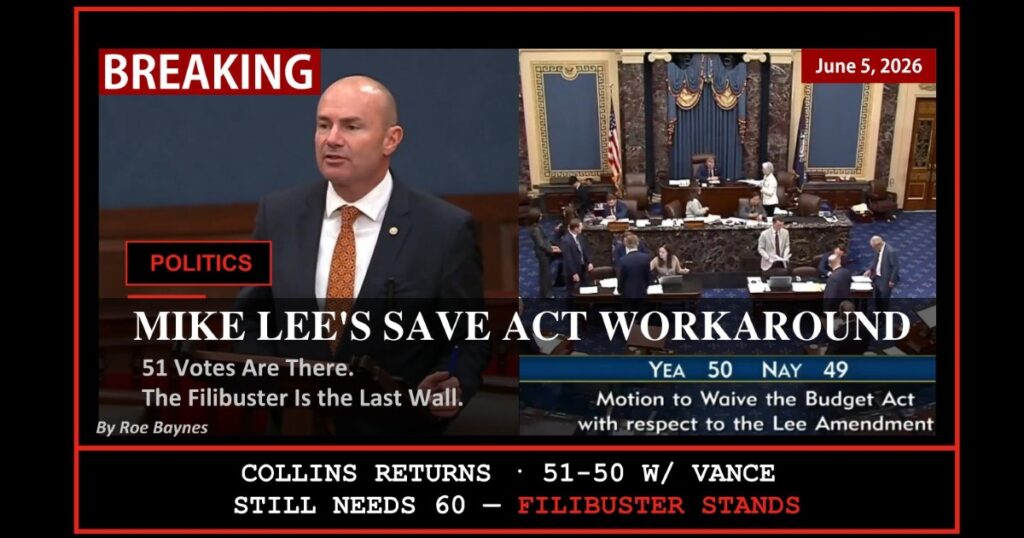
During overnight vote-a-rama on the immigration enforcement reconciliation package, Lee announced he is offering the House-passed version of the SAVE America Act as an amendment on the Senate floor. The key word is “House-passed” — meaning stripped of the controversial provisions added in the Senate that drove four Republicans to vote against it just hours earlier.
What Was Stripped — And What Stayed
The previous Senate version of the SAVE Act had been “stuffed with bad ideas” according to multiple Republican and Democratic critics alike. The provisions that pushed Collins, Murkowski, McConnell, and Tillis to vote against it included:
Stripped from Lee’s new amendment:
- The Schmitt mail-in voting restrictions — Sen. Eric Schmitt’s amendment that would have effectively banned mail-in voting nationwide except for narrow hardship exceptions. This was the biggest single sticking point for all four Republican holdouts.
- The expanded DHS voter roll surveillance provisions — additional language that would have given the federal government broad new authority to demand the removal of specific voters from state rolls.
- The immediate-effect timing provisions — language that would have implemented the bill in the middle of an active election year.
What stayed in the House-passed version:
- Proof of citizenship — Documentary proof such as a U.S. passport or birth certificate when registering to vote
- Photo ID — Government-issued photo identification to cast a ballot in federal elections
- In-person registration — Documentary proof presented in person to a state election official
- Voter roll cleanup — States must use a federal DHS citizenship database to verify rolls
- Penalties for election officials who register voters without verifying citizenship
The stripped-down version focuses on the original two core principles — only U.S. citizens vote in federal elections, and voters must present photo ID at the polls.
Susan Collins Returns to Yes
Collins’s opposition Thursday was driven specifically by the mail-in voting restrictions. As her office stated months ago: “Senator Collins supports the law and constitutional interpretation that only American citizens are eligible to vote in federal elections. She also supports voter ID. So she supported the original SAVE Act. There were problems with the SAVE America Act because it went much broader than these original principles.”
With those broader provisions stripped, Collins is back to supporting the bill — exactly as she did in February when Mike Lee announced she was the 50th Republican backer of the original House-passed version. That brings the math back to a hypothetical:
51-50 with JD Vance as the tiebreaker.
50 Republicans plus Vance gets the bill past a simple majority vote. Collins, Murkowski, McConnell, and Tillis would all reportedly support the stripped-down version — though the public confirmation list remains fluid.
The Catch — The Filibuster Still Stands
Here is where the math falls apart again. A simple 51-vote majority gets you nothing in the Senate without first overcoming the 60-vote filibuster threshold required to end debate on most legislation. The SAVE Act, even in its stripped-down form, still needs 60 votes to actually pass — not just 51.
Every Democrat has voted against ending debate on every version of this bill. Without seven Democrats crossing over — which is not happening — the 60-vote threshold cannot be reached through normal Senate procedure.
That leaves two paths forward, both of which Republicans have so far refused to take:
Option 1 — Nuke the filibuster. Eliminate the 60-vote threshold entirely through a simple majority procedural vote and pass legislation with 51 votes going forward. This is the “nuclear option” that Democrats used in 2013 for executive branch nominations and Republicans used in 2017 for Supreme Court nominations. But Collins has explicitly said she will not vote to change filibuster rules even though she supports the bill itself. McConnell has been the chamber’s most ardent filibuster defender for decades.
Option 2 — Talking filibuster. Force Democrats to actually stand on the floor and physically filibuster the bill — speaking continuously to prevent a vote. Lee has been pushing this for months. The problem is the talking filibuster requires the majority to maintain a quorum at all times while the minority only needs one senator speaking. Historically the majority always loses these battles eventually.
The reality: Lee’s stripped-down amendment proves the bill has 51 votes. The bill still does not have 60 votes. And Republicans are not yet willing to change the rules that allow 41 senators to block legislation that 71% of Americans support.
The Pressure Cooker
This is the core dynamic now driving the entire 2026 legislative environment. Trump has been clear — he wants the filibuster gone. As he wrote on Truth Social earlier this year: “We cannot let the Democrats get away with NO VOTER I.D. any longer. These are horrible, disingenuous CHEATERS.”
Mike Lee has been even more direct: “If your senators don’t support using the talking filibuster to pass the SAVE America Act, you might need to replace them.”
But Republican senators themselves — particularly Collins, Murkowski, and McConnell — have repeatedly refused to take that step. Their reasoning is straightforward: Democrats will eventually regain the majority, and when they do they will pack the Supreme Court, add Washington DC and Puerto Rico as states, and pass H.R. 1 federalizing all elections — all with simple majorities if the filibuster is gone.
This is the core tension in the Republican Party right now and it ties directly to the broader RINO purge we have been covering: voters want results. Establishment senators want institutional preservation. Those two things are now in direct conflict. Lee’s amendment forces every Republican senator to choose publicly between the two — and the next vote on this stripped-down version will reveal who picks which side.
My 2 Cents
I have been clear from the start where I stand on the SAVE Act. I support it. I believe voter ID is common sense. I believe only American citizens should vote in American federal elections. The polling shows the vast majority of Americans agree — including significant majorities of Black Americans, Latino Americans, and independents. This is not a fringe position. This is the consensus position of the country.
I would love to see Mike Lee’s stripped-down version pass. It addresses the legitimate concerns the four Republican holdouts had about the mail-in voting provisions while preserving the core principles voters across party lines actually support.
But I am deeply uncomfortable with the path required to get there. As I wrote in our original Cassidy piece and again in the Texas Senate Race coverage — I do not support eliminating the filibuster, even to pass legislation I personally agree with. The filibuster is one of the few remaining checks and balances in the Senate that forces compromise and prevents either party from running roughshod over the other when they hold a narrow majority. Eliminating it now to pass the SAVE Act guarantees Democrats will use the same tool to pass things I do not agree with the next time they hold the majority. And that day is coming — possibly as soon as 2027.
The honest position: I want the SAVE Act passed. I do not want the filibuster nuked to do it. Those two things may be impossible to reconcile in this Senate. And if they are — I would rather see the bill fail this Congress than see the filibuster eliminated. Some institutional protections matter more than any single piece of legislation, no matter how good that legislation is.
Whether Republican senators see it the same way — or whether Trump’s pressure eventually forces the issue — will be the defining question of the rest of this Congress. Watch it closely.
For full background on the SAVE Act and the four Republicans who voted against it Thursday, read our original coverage → SAVE Act Dies in the Senate — Again. Four Republicans Help Democrats Block It.