

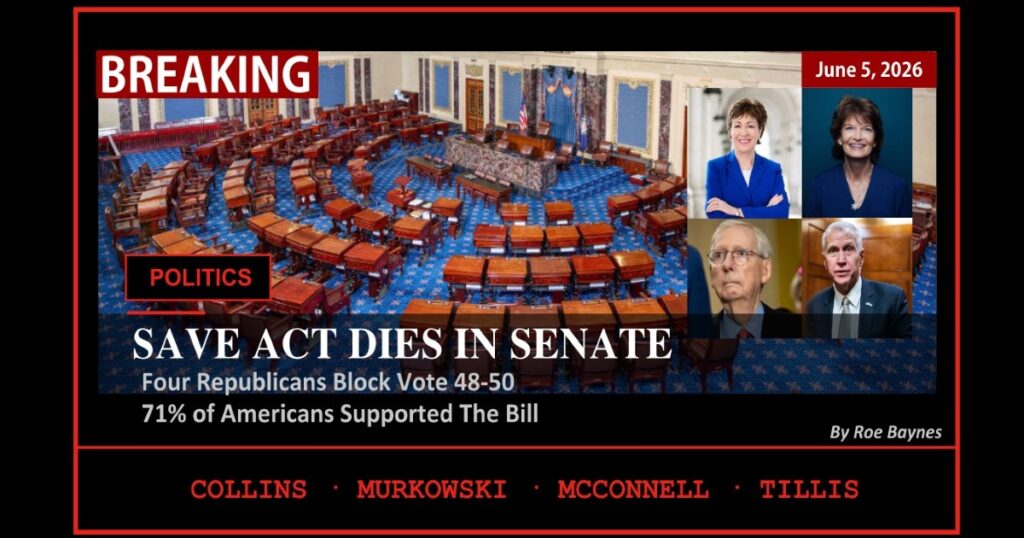
BREAKING — Published June 5, 2026 · By Roe Baynes · 5 Min Read
For background on the broader filibuster debate and how this connects to the 2026 Senate races read our complete political coverage at baynesworld.com
The SAVE America Act — President Trump’s signature election integrity legislation — failed in the Senate on Thursday for the second time this year. The vote was 48-50. Four Republican senators joined every Democrat in the chamber to block the bill from being attached to a $70 billion immigration enforcement funding package.
The four Republicans who voted against it: Susan Collins of Maine, Lisa Murkowski of Alaska, Mitch McConnell of Kentucky, and Thom Tillis of North Carolina.
What’s Actually in the Bill
The Safeguard American Voter Eligibility Act — better known as the SAVE America Act — was introduced in February 2026 by Rep. Chip Roy (R-TX). It passed the House 220-208, with four Democrats joining every Republican: Jared Golden (ME), Marie Gluesenkamp Perez (WA), Henry Cuellar (TX), and Ed Case (HI).
The bill would require:
- Proof of citizenship — Documentary proof such as a U.S. passport or birth certificate when registering to vote or updating registration
- Photo ID — Government-issued photo identification to cast a ballot in federal elections
- In-person registration — Documentary proof must be presented in person to a state election official
- Voter roll cleanup — States must use a federal Department of Homeland Security citizenship database to clean their voter rolls
- Penalties — Significant federal penalties for election officials who register voters without verifying citizenship
The bill applies only to federal elections — presidential, House, and Senate. State and local election rules remain under state control.
What the Polling Actually Shows
This is where the political math gets uncomfortable for Senate Democrats — and for the four Republicans who joined them. The polling on proof-of-citizenship and voter ID requirements is not close.
A February 2026 Harvard CAPS/Harris poll found:
- 71% of registered voters support the SAVE America Act overall — including 91% of Republicans, 69% of independents, and 50% of Democrats
- 81% support requiring voter ID — including 79% of independents and 70% of Democrats
- 75% support proof of citizenship to vote
- 80% support states removing non-citizens from voter rolls
- 85% agree only U.S. citizens should vote in U.S. elections — including 84% of independents and 82% of Democrats
A Pew Research Center poll found 83% of Americans favor voter ID requirements — including wide majorities of Democrats, independents, Whites, Blacks, and Latinos.
The crucial data point: support for these requirements is not a white, conservative, rural phenomenon. Black Americans and Latino Americans — the very groups Democrats argue would be disenfranchised — overwhelmingly support voter ID and proof-of-citizenship requirements at rates that mirror the broader American public.
The Democratic Narrative
Senate Minority Leader Chuck Schumer has been the loudest voice in opposition. “The SAVE Act is nothing more than Jim Crow 2.0. It could disenfranchise millions of American citizens,” Schumer said during the Senate debate.
The Democratic argument rests on three core claims:
The disenfranchisement argument — Democrats argue that millions of eligible American voters do not possess easy access to documentary proof of citizenship. A passport costs $130 to obtain. A certified birth certificate requires navigating state vital records bureaucracy. Voting rights advocates argue the measure would disproportionately impact women whose current names do not match their birth certificates, military members serving abroad, rural voters, disabled voters, and low-income Americans — with some Democrats comparing the documentation costs to a poll tax. Rep. Joe Morelle (D-NY), the top Democrat on the Committee on House Administration, called the SAVE Act “one of the most damaging voter suppression bills in modern history.”
The “solving a problem that does not exist” argument — Democrats argue that non-citizen voting is exceedingly rare and that existing federal law already imposes severe consequences including fines, up to five years in prison, and deportation for non-citizens who attempt to register or vote.
The Republican Narrative
Republicans counter that the bill is common-sense election integrity legislation that brings federal elections in line with how other secure activities already operate in American life.
The basic logic argument — Photo ID is already required to fly, buy alcohol, purchase a firearm, open a bank account, rent a car, get married, apply for unemployment, or apply for federal assistance programs. Requiring it to participate in the most important civic function in the country is not extreme — it is the bare minimum. Senate Majority Leader John Thune said likening the bill to Jim Crow “insults the overwhelming majority of Americans — including minorities — who look at voter ID and see nothing more than common sense.”
The election integrity argument — Republicans argue the bill is necessary to prevent non-citizen voting in federal elections and to restore public confidence in election outcomes. Trump himself has repeatedly framed the legislation as essential: “America’s Elections are Rigged, Stolen, and a Laughingstock all over the World. We are either going to fix them, or we won’t have a Country any longer.”
The public mandate argument — When 71% of Americans support a piece of legislation, including 50% of Democrats, the small number of senators blocking it are operating against the clear democratic will of the country they are elected to represent.
The Pros and Cons
Here is the most honest assessment of the SAVE Act, separated from partisan rhetoric.
Arguments For Passing the Bill
1. It reflects strong democratic consensus. When 71% of Americans across party lines support a piece of legislation it has democratic legitimacy that the current Senate filibuster math obscures. Government should generally reflect what its citizens actually want.
2. It aligns federal elections with other secure activities. The argument that ID is required for far less consequential activities than voting is rhetorically powerful and difficult to counter on the merits.
3. Black and Latino Americans overwhelmingly support it. When the very communities that opponents claim would be disenfranchised support the legislation by wide margins, the disenfranchisement argument loses much of its moral force.
Arguments Against Passing the Bill
1. Implementation costs would be significant. States would need to update voter registration systems, train officials, and process documentation for millions of voters. The federal government has not appropriated funds to offset these costs.
2. The documentation requirements create real friction. A passport costs $130 and takes weeks to obtain. Birth certificates can require navigating state bureaucracies, especially for older Americans born in states they no longer live in. While none of this prevents voting in absolute terms, friction does suppress participation at the margins.
3. Name change issues for women. A significant percentage of married American women have current legal names that do not match their birth certificates. The bill would require additional documentation to bridge that gap, creating a real-world hurdle that disproportionately affects women.
What Happens Now
The SAVE Act has officially failed in the Senate. Senate Majority Leader John Thune indicated last month that he is “less than eager to return to” the bill once other priorities are handled. Trump has publicly pressured the Senate to eliminate the filibuster to allow the bill to pass with a simple majority — but that effort has stalled given the lack of votes among Republican senators themselves for filibuster reform.
The four Republicans who voted against the bill are also the same four Republicans who consistently vote against many of Trump’s signature legislative priorities. All four have at various points been labeled RINOs by the MAGA base. Tillis has already announced his retirement. Collins faces a competitive re-election fight in November. Murkowski’s term runs through 2028. McConnell announced his retirement and his term ends January 2027.
The SAVE Act is now functionally dead for this Congress. Whether the 71% public support eventually translates into political pressure significant enough to move those four senators will likely be answered in the 2026 midterms.
For our complete coverage of the four Republicans involved in this vote — including Collins’s upcoming June 9 primary and the broader Republican civil war — visit baynesworld.com.