
BREAKING — Published May 24, 2026 · By Roe Baynes · 9 Min Read
For background on the Trump administration’s foreign policy moves read our complete coverage at Baynesworld.com
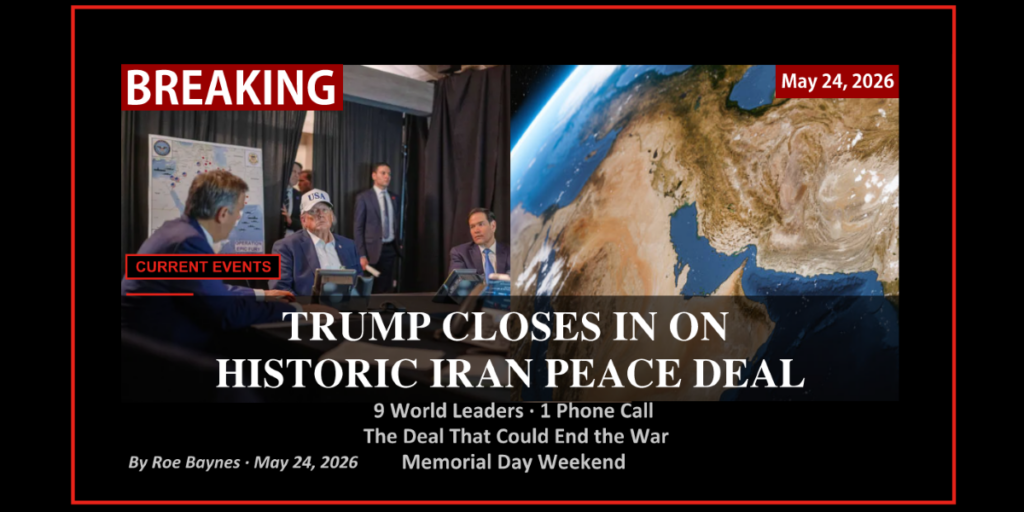
What was supposed to be a quiet Memorial Day weekend at the White House has turned into one of the most consequential 72-hour stretches of Donald Trump’s second term. Reports indicate the president abruptly redirected his holiday weekend plans to the Situation Room as negotiations to end the war with Iran enter what may be their final phase — with a sweeping peace deal that touches everything from highly enriched uranium to the Strait of Hormuz reportedly hanging in the balance.
The War So Far — A Quick Timeline
The United States and Israel launched coordinated strikes against Iran on February 28, 2026, in what was designated Operation Epic Fury — a joint campaign aimed at destroying Iran’s nuclear infrastructure and decapitating its leadership. The strikes hit nuclear facilities at Fordow, Natanz, and Isfahan, and ultimately killed Iran’s Supreme Leader Ali Khamenei. Iran responded with missile and drone strikes against Israel, U.S. military bases across the Middle East, and U.S.-allied Gulf states. Iran also closed the Strait of Hormuz — through which approximately 20% of the world’s daily oil supply moves — sending global energy prices into chaos and U.S. gas prices past $8 per gallon in some regions.
After 40 days of sustained combat, a conditional two-week ceasefire was announced on April 8, 2026, mediated by Pakistan’s Field Marshal Asim Munir. As of today the ceasefire has held for 46 days — bringing the total length of the conflict to 86 days since the first U.S. strike.
The Pentagon’s official estimate as of late April put the war’s cost to U.S. taxpayers at $25 billion — though insiders familiar with the figures told CNN the real number is closer to $40-50 billion when accounting for damage to U.S. military bases and replacement of destroyed assets, with some independent analysts including the Penn Wharton Budget Model estimating the total economic impact at up to $210 billion.
The War Powers Question
Under the War Powers Resolution of 1973, the president must seek Congressional authorization for any military action lasting beyond 60 to 90 days. Trump’s position is that the April 8 ceasefire effectively paused that statutory clock — buying his administration time to negotiate without facing a vote in Congress that he may not win. Critics in both parties have challenged that interpretation, but with negotiations now reportedly near a final deal the legal question may become moot.
The Saturday Call — Trump’s Truth Social Bombshell
The breakthrough came Saturday. In a lengthy Truth Social post from the Oval Office, President Trump revealed he had just completed an extraordinary multi-party phone call with the leaders of nine countries — directly addressing the Islamic Republic of Iran and “a Memorandum of Understanding pertaining to PEACE.”
Trump spoke with the leaders of Saudi Arabia, the UAE, Qatar, Pakistan, Turkey, Egypt, Jordan, and Bahrain — every major Sunni Arab power plus Pakistan’s Field Marshal Asim Munir, the war’s lead mediator throughout.
Trump wrote: “An Agreement has been largely negotiated, subject to finalization between the United States of America, the Islamic Republic of Iran, and the various other Countries, as listed.” He then noted he had separately spoken with Israeli Prime Minister Benjamin Netanyahu — a call that he said “likewise, went very well.”
Trump closed the post with a single bombshell line: “In addition to many other elements of the Agreement, the Strait of Hormuz will be opened.”
The Reported Deal — What We Are Hearing
A clear note before we go further: The terms below are based on leaked details and reporting from regional sources. Nothing has been signed, certified, or officially announced. Treat these as rumors until confirmed.
According to multiple reports compiled by entrepreneur and political commentator Patrick Bet-David — himself born in Tehran and a refugee of the Iranian Revolution — here is what is reportedly on the table:
- Iran gives up its 400 kg stockpile of highly enriched uranium — enough material for approximately 11 nuclear weapons
- The United States begins a phased unfreezing of Iran’s $6-30 billion in frozen cash assets
- The Strait of Hormuz reopens to global shipping
- Iran agrees to charge no toll on ships passing through — no $2 million fee per vessel
- The U.S. agrees to lift some sanctions as part of the broader package
- The war officially ends on all fronts including the Lebanon conflict
- U.S. forces stationed near Iran will withdraw
- A 30 to 60 day window to finalize the full nuclear agreement
Iran’s Fars news agency, affiliated with the Islamic Revolutionary Guard Corps, has already disputed Trump’s framing — claiming the deal on the table would still keep the Strait under Tehran’s control and dismissing Trump’s claim of being close as “incomplete and inconsistent with reality.” That public posturing may simply be Iranian hardliners trying to save face domestically — or it may indicate real disagreement on key terms.
Patrick Bet-David Breaks Down the Winners and Losers
Patrick Bet-David — the Iranian-born American entrepreneur, founder of Valuetainment, and political commentator who fled Iran as a refugee during the Iranian Revolution — published a detailed analytical breakdown of what this deal would mean if it goes through. His framework captures the geopolitical chess board better than most professional analysts.
Bet-David’s analysis identifies clear winners and losers. On the winning side: the American people facing lower oil prices and inflation relief, President Trump with a major foreign policy win, global markets, and surprisingly China — which was hurt most by the Strait of Hormuz closure. On the losing side: the Iranian people who will face a victorious IRGC cracking down harder than ever, Netanyahu who wanted regime change for his legacy, defense contractors and warhawks who wanted the war to continue, and Democrats facing a Trump foreign policy win heading into the midterms.
Notably, the warhawks now criticizing the deal in public appear on Bet-David’s loser list precisely because they wanted the war to continue — which explains everything about the pushback that came next.
The Warhawks Push Back — And Trump Fires Back
The hawkish wing of the Republican Party has erupted over the reported terms — and they have not been quiet about it.
Sen. Ted Cruz (R-TX) said on X he was “deeply concerned about what we are hearing about an Iran ‘deal’.” He warned that “if the result of all that is to be an Iranian regime — still run by Islamists who chant ‘death to America’ — now receiving billions of dollars, being able to enrich uranium and develop nuclear weapons, and having effective control over the Strait of Hormuz, then that outcome would be a disastrous mistake.”
Sen. Lindsey Graham (R-SC) — a longtime Trump ally and one of the war’s most vocal supporters — warned that a deal that effectively recognizes Iran’s ability to control the Strait of Hormuz would represent “a major shift of the balance of power in the region” and could prove a “nightmare for Israel.”
President Trump fired back on Truth Social with a direct shot at his own party’s hawks:
“If I make a deal with Iran, it will be a good and proper one, not like the one made by Obama, which gave Iran massive amounts of CASH, and a clear and open path to a Nuclear Weapon. Our deal is the exact opposite, but nobody has seen it, or knows what it is. It isn’t even fully negotiated yet. So don’t listen to the losers, who are critical about something they know nothing about. Unlike those before me who should have solved this problem many years ago, I don’t make bad deals! President DJT”
It was vintage Trump — publicly slapping down his own party’s establishment hawks while defending his diplomatic flexibility. The same MAGA-vs-establishment dynamic that has played out across this Republican Party for months has now arrived at the foreign policy table. The warhawks Cruz and Graham are finding themselves on the opposite side of a Trump foreign policy decision — and Trump is publicly calling them out as “LOSERS” for it.
The military industrial complex angle here cannot be ignored. Defense contractors and the politicians who depend on their campaign contributions have a direct financial interest in continued conflict — and a direct financial loss from a successful peace deal. When senators who have spent their careers calling for more military action suddenly raise alarm bells about ending a war, it is worth asking who benefits from that position and who funds it.
What This Means for Trump’s 2026
If this deal holds and gets signed, the timing could not be more politically favorable for Trump and Republicans. Trump’s birthday arrives June 14 — barely three weeks away. The United States co-hosts the FIFA World Cup beginning in June. The 250th anniversary of American independence falls on July 4. A signed peace deal arriving at the start of this stretch would be a historic narrative that writes itself — and heading into the 2026 midterms, a major foreign policy win significantly improves Republican odds, energizes the base, and undercuts Democratic arguments about Trump’s foreign policy temperament. Trump-backed candidates including Paxton in Texas would benefit directly. The political stakes for Trump personally are enormous. So are the risks.
The Risk Factor
Three things could still go wrong before any deal is signed.
Israel breaking the ceasefire. The April 8 ceasefire was violated within hours by both sides — 16 killed in Iran and 4 killed in Israel before U.S. pressure stabilized the truce. Israel has repeatedly demonstrated a willingness to act unilaterally when it believes its security demands it.
Iranian hardliners derailing the deal. The Fars news agency dismissal of Trump’s framing this weekend may indicate genuine internal Iranian opposition. Khamenei is dead, but the IRGC remains powerful and may not accept terms that other Iranian leaders are willing to sign.
The warhawks finding leverage. With Congressional ratification possible and military funding decisions still pending, Cruz, Graham, and the broader hawkish wing of the GOP still have institutional power to slow or complicate a final agreement even if they cannot directly stop it.
My 2 Cents
I will be honest about where I started on this story. I was part of the “no more wars” crowd during Trump’s first campaign and I was genuinely pleased throughout most of his second term that he had not started major new military conflicts the way nearly every administration before him did. That is one of the things I appreciated most about Trump as a leader — a real reluctance to commit American military force unless absolutely necessary.
I was wary of the Venezuela operations earlier this year but ultimately relieved that no American lives were lost. When the Iran strikes happened in February I was not happy about it — I had genuinely believed that last year’s surgical strikes had already decapitated Iran’s nuclear program and that further escalation was unnecessary. I do not support American troops on the ground in foreign countries. I hate seeing reports of American service members losing their lives no matter how small the number. And I stand firmly against the military industrial complex and the lobbyists who push for endless conflict out of greed and a thirst for profits — along with the politicians in both parties who do their bidding.
That said, I am intellectually honest enough to acknowledge the harder truth: if Iran was genuinely working toward nuclear weapons capability — and assuming we are not being lied to by our own government the way we were lied to about weapons of mass destruction in Iraq — then I do currently support the operations that have unfolded. A nuclear-armed Iran governed by an Islamist theocracy that openly chants “death to America” is not an acceptable outcome for the United States or for the region. That is a position I do not arrive at lightly.
I am hopeful — genuinely, cautiously hopeful — that this conflict ends with a real peace deal that brings lasting stability to the Middle East. I am also worried. Worried that the IRGC or Israel will break the ceasefire. Worried that the warhawks will find a way to throw a wrench in the negotiations. Worried that something will go wrong in the final stretch and pull us back into a war that has already cost between $25 and $50 billion of American taxpayer money and the lives of American service members.
But if this deal sticks — and I hope it does — it will be undeniably a major win for President Trump. He deserves the credit for getting this done regardless of what the naysayers, the warhawks, or the establishment narrative tries to spin afterward. A negotiated end to a war is always better than a continuation of one — and a peace deal that holds is the kind of legacy moment that defines presidencies.
Watch the next 72 hours closely. Memorial Day weekend may end up being one of the most historic of Trump’s presidency — or one of the most disappointing. We will know soon enough.
This article will be updated as the situation develops. For ongoing coverage of the Iran negotiations and the broader Trump foreign policy agenda follow Baynesworld.com.