

BREAKING — Published June 30, 2026 · By Roe Baynes · 3 Min Read
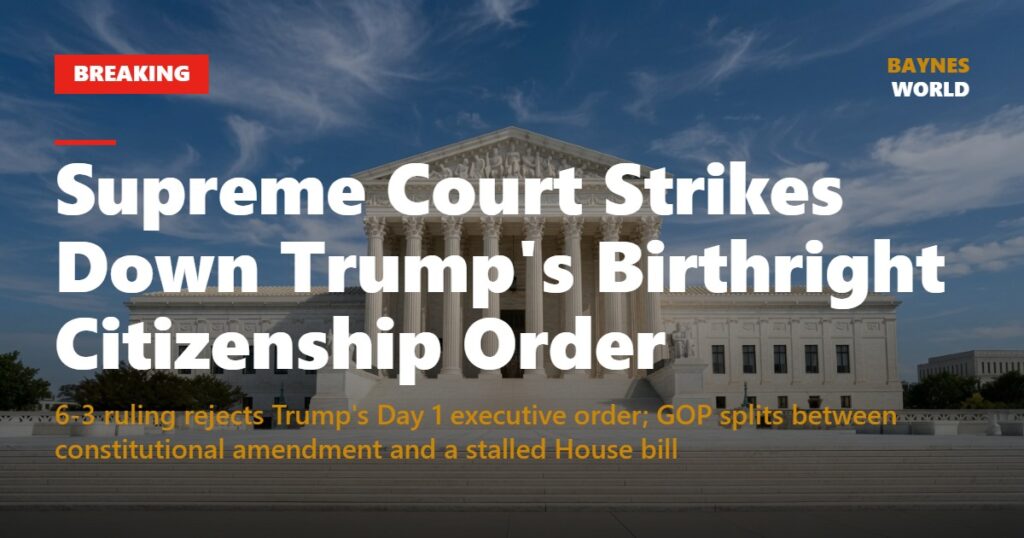
The Supreme Court on Tuesday rejected President Trump’s executive order seeking to restrict birthright citizenship, ruling that the 14th Amendment guarantees automatic citizenship to nearly all children born on U.S. soil. The case, Trump v. Barbara, was the last of the term’s blockbuster decisions and delivered another defeat to the administration’s immigration agenda. Read the full opinion at the Supreme Court’s official site.
The Vote
The outcome was 6-3 against the order, but the reasoning splits differently. Chief Justice John Roberts wrote the majority opinion, joined by Justices Sonia Sotomayor, Elena Kagan, Amy Coney Barrett, and Ketanji Brown Jackson — five justices holding the order unconstitutional. Justice Brett Kavanaugh supplied the sixth vote against the order but on narrower grounds, agreeing only that a 1950s federal statute confers citizenship at birth, not that the Constitution requires it. Justices Clarence Thomas, Samuel Alito, and Neil Gorsuch dissented.
The Majority Opinion
Roberts grounded the ruling in the text and history of the 14th Amendment’s Citizenship Clause, tracing it through English common law and the Reconstruction-era debates that produced it. He wrote that the framers extended citizenship to “every free-born person in this land,” concluding the Court was simply keeping that promise. The opinion rejected the administration’s argument that citizenship should depend on a parent’s legal “domicile” in the U.S., finding no support for that limitation in the historical record.
The Dissent
Justice Thomas authored a 91-page dissent, joined by Gorsuch, arguing the majority’s account of the Citizenship Clause’s history is inaccurate and that the provision was originally understood as a narrower, race-specific remedy tied to freed slaves. Justice Jackson, writing separately, pushed back directly on that reading. Justice Alito dissented separately as well, warning the ruling “preserves a powerful incentive to enter or remain in this country illegally” and saddles the U.S. with a rule other common-law nations have since abandoned.
Trump’s Reaction
The president called the ruling “too bad for our Country” in a Truth Social post, but said “no long and unwieldy Constitutional Amendment is necessary” and urged Congress to act instead, pledging his “Complete and Total Support.” In a separate post, Trump made the same point while addressing Monday’s Trump v. Slaughter ruling — which overturned the 90-year-old Humphrey’s Executor precedent and expanded presidential removal power over independent agencies — writing that Republicans would “work to correct” the birthright citizenship “loss” in Congress. Trump also posted a sarcastic message congratulating Chinese President Xi Jinping on China’s “massive Birthright Citizenship WIN.”
The GOP Amendment Push
Within minutes of the ruling, Republican senators began calling for a constitutional amendment. Sen. Mike Lee of Utah set the tone in a post on X: “We’re going to need a constitutional amendment.” Sen. Eric Schmitt of Missouri called the decision “wrong, dangerous, and disastrous for American sovereignty,” and said an amendment would “restore the original American understanding of citizenship.” Sen. Rand Paul of Kentucky pointed to constitutional amendment language he introduced back in April, telling supporters upset with the ruling to back his proposal. Sens. Ted Cruz, John Cornyn, and Rick Scott also renewed calls for congressional action, while Florida Gov. Ron DeSantis said the ruling would require “either a constitutional amendment or a future court” to overturn it, calling it a “major defeat.” House Speaker Mike Johnson said Tuesday that leadership is weighing both an amendment and legislation, calling birthright citizenship “abused” but stopping short of committing to either path.
That legislative option already exists. H.R.569, the Birthright Citizenship Act of 2025, was introduced by Rep. Brian Babin (R-TX) back in January 2025 — alongside a Senate companion bill from Sen. Lindsey Graham — and would limit automatic citizenship to children with at least one parent who is a citizen, green-card holder, or active-duty service member. It has sat in the House Judiciary Committee without a vote for a year and a half.
What Comes Next
The two paths carry very different math. A constitutional amendment requires two-thirds majorities in both the House and Senate, plus ratification by 38 states — a bar no immigration-related amendment has cleared in modern history. H.R.569 needs only simple majorities to pass — but it’s had eighteen months to get one, and hasn’t moved.
Baynes World follows a public Impartiality Pledge on all political coverage.
More from Baynes World
- SCOTUS Upholds Trans Athlete Bans in Women’s Sports (pending permalink)
- Supreme Court Upholds Mail-In Ballot Grace Periods (pending permalink)
- Trump v. Slaughter: The Supreme Court Just Rewrote Presidential Power (pending permalink — queued)
- Communism Is the Greatest Threat to America — And I Learned That From My Family