

BREAKING — Published June 12, 2026 · By Roe Baynes · 4 Min Read
For background on the SAVE Act and the failed Senate vote read our previous coverage → SAVE Act Dies in the Senate and Mike Lee’s SAVE Act Workaround
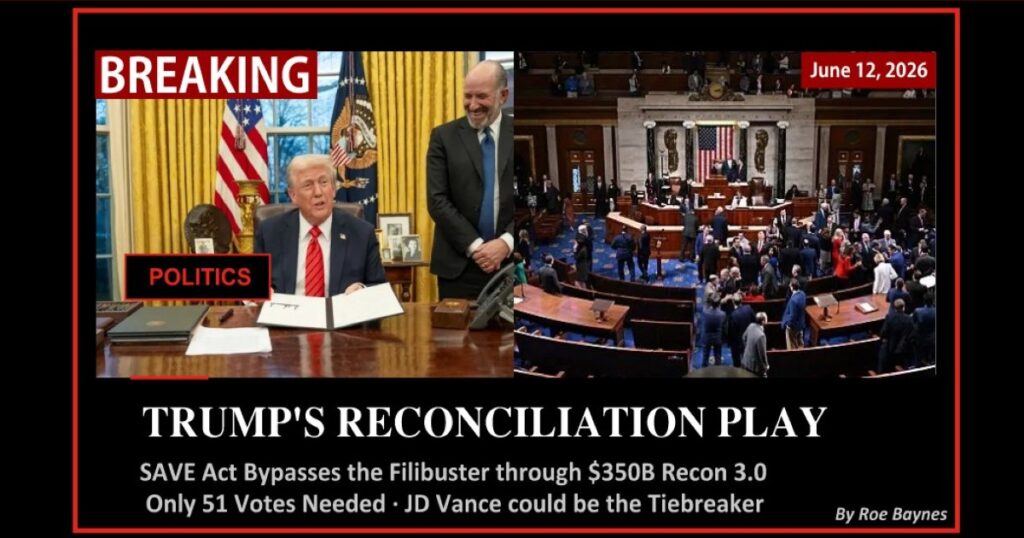
President Donald Trump on Wednesday called on Republicans in Congress to attach the SAVE America Act to a forthcoming $350 billion reconciliation bill — a maneuver that would allow the legislation to pass with just 51 votes instead of the 60 normally required by the Senate filibuster.
In a Truth Social post Wednesday afternoon Trump wrote: “No other President has ever been more committed to both REBUILDING our Great Military and SAVING our Great Country — And NOW is the time to make it happen, for Generations to come. I am hereby calling on Republicans in Congress to IMMEDIATELY advance and pass the forthcoming $350 Billion Reconciliation Bill (Recon 3.0) — which, at the request of our Great Department of War — will include THE SAVE AMERICA ACT as well. No games, no delays, and no weak compromises! Do this ASAP.”

What This Means
For the past several months we have covered the SAVE Act through three separate articles. The pattern has been the same throughout. Republicans have the votes for a simple majority. Democrats can block any normal piece of legislation by withholding the seven Republican-Democrat crossover votes needed to overcome the 60-vote filibuster threshold.
Trump’s Wednesday proposal sidesteps that math entirely. Budget reconciliation requires only 51 votes, not 60. With 50 Republicans expected to support the SAVE Act in its Mike Lee–amended form — including Susan Collins after the mail-in voting restrictions were stripped — Republicans need only Vice President JD Vance as the tiebreaker to pass it.
The genius of this move is that it accomplishes the same legislative outcome — passing the SAVE Act — without requiring Republicans to vote to nuke the legislative filibuster. The filibuster stays intact for future legislation. The SAVE Act passes regardless. Collins, Murkowski, and McConnell — who have all publicly refused to vote for filibuster elimination — can still vote for the reconciliation package without violating their stated position on procedural rules.
What’s in the Bill
The Mike Lee–amended version of the SAVE Act — which now appears headed for the reconciliation package — keeps the core election integrity provisions while stripping the most controversial additions that drove the four Republican holdouts away last week:
Still in the bill:
- Proof of citizenship — documentary proof such as a U.S. passport or birth certificate when registering to vote
- Photo ID — government-issued photo identification to cast a ballot in federal elections
- In-person registration — documentary proof presented in person to a state election official
- Voter roll cleanup — states must use a federal Department of Homeland Security citizenship database to verify rolls
- Federal penalties for election officials who register voters without verifying citizenship
Stripped from earlier Senate versions:
- The Schmitt mail-in voting restrictions
- The expanded DHS voter surveillance provisions
- The immediate-effect timing language
The Reconciliation Math
The $350 billion package — internally referred to as Recon 3.0 — is being framed primarily as a defense spending bill. The administration is requesting a $1.5 trillion total defense budget for FY2027, split between a $1.15 trillion base budget request and the $350 billion that requires reconciliation to pass. The base budget alone would represent a 28 percent increase from FY2026, with the reconciliation funds bringing the total to a 44 percent boost — historic territory for defense spending.
Adding the SAVE Act to this defense reconciliation package is unconventional but procedurally allowed. Reconciliation bills can include any provision that has a measurable budgetary effect, and election security provisions involving federal funding and DHS database integration qualify.
The Timeline — When Could This Actually Pass?
Recon 3.0 is not a simple up-or-down vote that can happen next week. The reconciliation process requires multiple procedural steps that take time even when one party controls both chambers and the White House. Here is the realistic path forward:
Step 1 — Budget Resolution (estimated 2-3 weeks)
Before any reconciliation bill can be drafted, both the House and Senate must pass an identical FY2027 budget resolution that includes reconciliation instructions specifically authorizing Recon 3.0. The current FY2026 budget resolution’s reconciliation instructions expire September 30, 2026 — so this new resolution must be passed and adopted by both chambers before any new reconciliation legislation can be drafted under FY2027 authority.
Step 2 — Committee Drafting (estimated 2-4 weeks)
Once the budget resolution is adopted, the relevant Senate and House committees — Armed Services, Judiciary, Homeland Security, and others depending on what is included — must draft the actual legislative text. The Mike Lee–amended SAVE Act would be inserted at this stage. For comparison, the Reconciliation 2.0 immigration package required from late April to late May 2026 to draft committee text.
Step 3 — Byrd Bath (estimated 1-2 weeks)
The Senate Parliamentarian conducts what is known as a “Byrd bath” — reviewing every provision in the reconciliation bill to ensure each one has a measurable budgetary effect and complies with the Byrd Rule. Provisions that fail this test get stripped out. This is the single biggest procedural risk for the SAVE Act inclusion. If the Parliamentarian rules that any of the SAVE Act’s election integrity provisions are primarily policy rather than budgetary in nature, those provisions get removed from the bill regardless of how Republicans vote.
Step 4 — Floor Vote (1-3 days of debate)
Once the bill survives the Byrd bath, it heads to the Senate floor. Reconciliation bills are not subject to filibuster but are subject to vote-a-rama — an unlimited amendment process that can last 12 to 18 hours. Senators can offer any amendments they want and force votes on each one. This is where the bill could be substantially altered before the final passage vote.
Step 5 — House Passage and Presidential Signature (estimated 1-2 weeks)
After Senate passage, the House must pass the identical bill before it can go to Trump’s desk. For comparison, House Republicans passed Reconciliation 2.0 in three weeks after the Senate version cleared.
The Realistic Bottom Line
If Republicans move fast and avoid procedural delays, Recon 3.0 could theoretically pass and be signed by late August or early September 2026. A more realistic timeline given the disagreements within the Republican caucus — particularly with Collins and McConnell openly questioning whether a third reconciliation bill should happen at all — is early to mid October 2026, just weeks before the November midterms. That timing has significant political implications. A signed SAVE Act in October would arrive as a major Republican legislative accomplishment heading into the election. A failed effort or a delayed vote that pushes into November would become a campaign issue. Either way the next four months will determine whether the SAVE Act becomes law this Congress.
The one hard deadline: reconciliation instructions tied to the FY2027 budget resolution expire September 30, 2027 — giving Republicans roughly 15 months from passing the new budget resolution to actually getting the reconciliation bill signed. That is a relatively generous window by reconciliation standards but every delay narrows the political calculation.
The Resistance
Not everyone in the Republican caucus is on board. The day before Trump’s post, Senate Appropriations Committee Chair Susan Collins and Senate Appropriations Defense Subcommittee Chair Mitch McConnell publicly cast doubt on a third reconciliation package. Collins called a third reconciliation bill a “terrible risk” that could create funding “instability” for defense efforts.
That puts Collins in a difficult position. She supports the SAVE Act in its Mike Lee–amended form — that has been her stated position for months. But she opposes the reconciliation vehicle that would actually get it passed. Whether she ultimately votes for or against Recon 3.0 will determine whether the SAVE Act becomes law this Congress.
The same calculation applies to McConnell. He has stated he supports common-sense election integrity but opposes both filibuster reform and the third reconciliation package. Trump’s move forces him — and Collins, and Murkowski, and any other holdouts — to choose between their stated policy preference and their stated procedural preference. They cannot have both.
My 2 Cents
I have been consistent throughout this coverage on both points. I support the SAVE Act. I do not support eliminating the filibuster. Trump’s move on Wednesday is the cleanest possible reconciliation of those two positions — passing the legislation without changing the rules that protect future minorities of either party from one-party legislative dominance.
This is good political strategy. It is also good institutional strategy. The filibuster remains intact for future fights — including the inevitable Democratic majority that will arrive in some future Congress and would otherwise use a Trump-era filibuster elimination as the precedent to pass their own agenda with simple majorities.
For those of us who want both election integrity and institutional protection, Recon 3.0 is the path that delivers both. The question now is whether enough Senate Republicans will see it the same way — or whether Collins, McConnell, and the defense appropriators will block the procedural vehicle that delivers their own preferred policy outcome.
Realistically we are looking at a vote sometime between late August and early October. That puts the timing right in the heart of the 2026 midterm campaign — which means every Republican senator who votes against this will be voting against it knowing their primary voters are watching. That political pressure may end up being the deciding factor regardless of how Collins, McConnell, and the others feel about reconciliation procedurally.
Watch the budget resolution vote in the next few weeks. That will be the first signal of whether Recon 3.0 has the votes to move forward at all. If the budget resolution fails, the entire SAVE Act reconciliation path collapses before it even begins.
For our complete coverage of the SAVE Act and the broader 2026 legislative battle, visit baynesworld.com.