

FINANCE · NEWS — Published June 13, 2026 · By Roe Baynes · 4 Min Read
Disclosure: This article is for informational purposes only and does not constitute financial advice. Read our full Disclosure Policy at baynesworld.com/disclosure-policy.
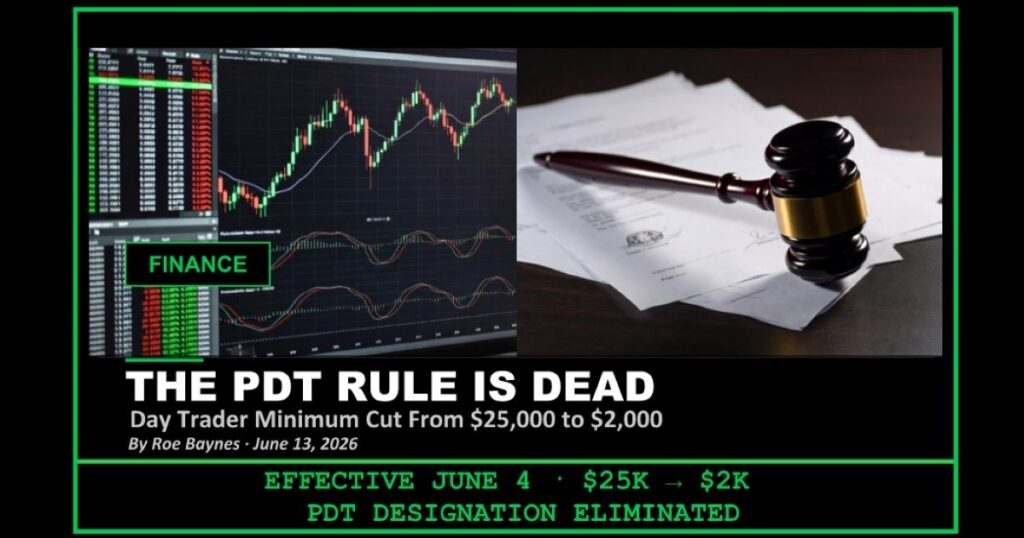
For 25 years the Pattern Day Trader rule kept millions of Americans locked out of active stock trading. As of June 4, 2026, it is gone.
The Securities and Exchange Commission has officially eliminated the PDT designation entirely — replacing the rule’s $25,000 minimum equity requirement with the standard $2,000 margin account minimum. The change took effect last Wednesday and represents arguably the most significant expansion of retail trading access since online brokerages eliminated commissions in 2019.
What the Old Rule Did
The Pattern Day Trader rule was created by FINRA in February 2001, in the aftermath of the dot-com crash. The logic at the time was straightforward — retail traders were getting wiped out by volatile tech stocks, and regulators wanted to create a financial barrier between casual investors and active day trading.
Under the old framework, any margin account holder who executed four or more day trades within five business days was automatically classified as a Pattern Day Trader. Once that designation was applied, the trader was required to maintain a minimum equity balance of $25,000 in their account at all times. Drop below that threshold and your account was restricted to closing positions only — no new day trades allowed for 90 days.
For most retail investors $25,000 was a wall they could not climb. Even traders who wanted to learn active trading with smaller capital were locked out. The rule effectively divided the American retail investor population into two groups: those wealthy enough to day trade and everyone else.
What Changed on June 4
The SEC approved FINRA’s amendments to Rule 4210 on April 14, 2026. FINRA published Regulatory Notice 26-10 on April 20, setting the effective date as June 4. The change has now taken effect, with brokerages phasing in full implementation through October 20, 2027.
Here is what is gone:
- The $25,000 minimum equity requirement — eliminated entirely
- The four-day-trades-in-five-days threshold — eliminated
- The Pattern Day Trader designation itself — no longer exists under federal regulation
- Account restrictions for accounts under $25,000 — no longer apply
- End-of-day calculations of day-trade buying power — replaced
Here is what is replacing it:
- A $2,000 minimum equity requirement — the same standard margin account minimum that has always existed
- Real-time intraday margin monitoring — your buying power is calculated based on your actual account capacity in real time, not based on counting how many trades you have made
- Risk-based margin requirements — your margin level is determined by the actual risk of your positions, not by an arbitrary trade count
In practical terms: any American with $2,000 and a margin account can now day trade without restriction. The wall is gone.
What Brokerages Are Doing
Major brokerages began rolling out their PDT eliminations the day the rule took effect:
Charles Schwab announced on June 8 that it would stop counting day trades and no longer restrict accounts that would have previously been flagged as pattern day traders. Schwab will not open any new PDT-restricted accounts as of that date.
Robinhood, E*TRADE, Fidelity, Webull, Firstrade, tastytrade, and TradeZero have all confirmed they are implementing the new framework. Most have moved within days of the effective date.
The market reacted immediately. Robinhood shares jumped roughly 7.6% to $85.11 in the days following the rule change. Webull climbed 9%. Investors clearly understood what this meant for retail trading volume going forward — more active traders, more transactions, more revenue for the brokerages that capture that volume.
One important caveat: Brokerages are not required to eliminate all internal restrictions. Some firms may implement their own internal guardrails that functionally resemble the old PDT rule — particularly for accounts under specific size thresholds. Others, particularly those competing for retail market share, may take a lighter touch. Check with your specific broker on what their internal policies look like in the new framework.
Why This Matters
This is the single biggest expansion of retail trading access in a quarter century. The $25,000 PDT minimum was originally created to protect inexperienced traders from rapid losses during a period of high commissions, limited risk monitoring technology, and slower market information flow. None of those conditions still exist. Commissions are zero. Risk monitoring is real-time across virtually every brokerage. Market data flows instantly to every retail trader’s phone.
The rule that made sense in 2001 stopped making sense years ago. The SEC finally acknowledged that reality.
The expanded retail access also arrives at a moment when the broader regulatory environment is opening up dramatically. SpaceX’s IPO this week reserved 30% of its offering for retail investors and prompted Fidelity to drop its IPO eligibility threshold from $500,000 to just $2,000. Combined with the PDT elimination, this single week represents the most significant expansion of retail investor participation in American capital markets in two decades.
For active traders this is genuinely transformational. Trading strategies that required $25,000 of capital to attempt — momentum scalping, options day trading, news-driven swing trades — are now accessible to anyone with $2,000 and a margin account.
A Word of Caution
The rule is gone. The risk is not.
Day trading remains genuinely difficult. Multiple academic studies have consistently shown that the vast majority of retail day traders lose money over time — typically between 70% and 90% depending on the study. The original PDT rule was paternalistic, but the impulse behind it was not entirely wrong. Active trading is hard, and the players on the other side of your trades are sophisticated institutional traders with vastly better information, faster execution, and better risk management than any retail trader can match.
The regulatory protection is gone. That means the personal responsibility is now entirely on the individual trader to manage their own risk, position sizing, and capital preservation. The $25,000 wall was the government’s way of forcing traders to have enough capital to survive their early mistakes. Without that wall, the discipline has to come from inside the trader.
If you are considering taking advantage of the new framework — start small. Paper trade first. Treat your first $2,000 as tuition money you can afford to lose. Anyone telling you day trading is easy money has never actually tried it for a living.
The Bottom Line
The PDT rule is dead. American retail investors now have the freest access to active trading they have had in 25 years. Combined with the SpaceX IPO opening to $2,000 accounts and Fidelity dropping its IPO eligibility from $500,000, this week represents the largest expansion of retail access to American capital markets in a generation.
What individual traders do with that access will determine whether this regulatory shift produces a wave of new successful traders — or a wave of new losers learning expensive lessons. The wall is gone. The market is wide open. The discipline now lives entirely with each trader.
Trade carefully.
This article is for informational purposes only and does not constitute financial or investment advice. Always consult a licensed financial advisor before making investment decisions. Read our full Disclosure Policy at baynesworld.com/disclosure-policy.