

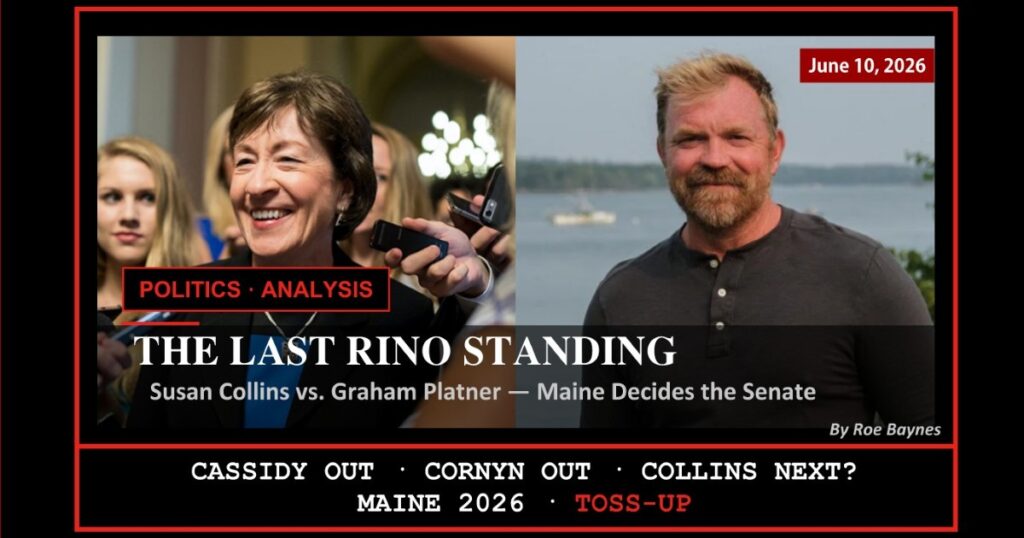
ANALYSIS — Published June 9, 2026 · By Roe Baynes · 9 Min Read
Part 2 of our 2026 Midterms Series. For our complete election coverage visit baynesworld.com
📋 2026 MIDTERMS SERIES Part 1: The RINO Purge of 2026 (coming soon) Part 2: Susan Collins — The Last RINO Standing ← You are here Part 3: North Carolina — Cooper vs. Whatley (coming soon) Part 4: Georgia — Ossoff and the Senate Race (coming soon) Part 5: The 2026 Senate Map — Full Overview (coming soon)
Last night Maine voters made it official. Susan Collins emerges from her uncontested Republican primary, Graham Platner wins the Democratic nomination after Governor Janet Mills suspended her active campaign, and the most watched Senate race in America is officially set for November 3.
But here is what makes this race the defining story of the entire 2026 cycle: Susan Collins is the last of seven Senate Republicans who voted to convict Donald Trump in 2021 still standing and still facing voters. The other six are gone. Burr, Toomey, and Sasse retired before facing voters again. Romney chose not to run in 2024. Murkowski survived her 2022 general election and is safe until 2028. Cassidy was defeated in his Louisiana primary just weeks ago. Cornyn was defeated by Ken Paxton on May 26.
That makes Susan Collins the final test case for whether MAGA-era Republicans who broke with Trump on his most defining moment can survive in the era he has created.
Who Susan Collins Is
A 30-year veteran of the Senate. First elected in 1996 on a pledge to serve no more than two terms — a promise she has now broken three times running for her sixth term. The last remaining Republican member of the entire New England Congressional delegation. A vote that Republicans have counted on for decades in the institutional sense and a vote that has reliably broken from her own party on the specific moments that matter most. She is, in every sense, the embodiment of the old Republican Party — the one being systematically dismantled around her.
Why Collins Got a Free Pass From Her Own Party
In an era of MAGA primary challenges that have toppled Cassidy, Cornyn, Crenshaw, and forced Ernst and Tillis into retirement, one obvious question demands an answer: why did Susan Collins skate through her Republican primary essentially unopposed?
Technically Collins did have two challengers on Tuesday’s ballot — Carmen Calabrese and Daniel Smeriglio — but both were such low-profile candidates that virtually every major news outlet has described her primary as “uncontested” or “unopposed.” She faced no serious MAGA-aligned challenger of any kind. No Trump-endorsed contender. No state legislator. No congressional candidate making the jump. Nothing resembling the Paxton-vs-Cornyn dynamic that defined the Texas Senate race or the Letlow-and-Fleming wave that took down Cassidy in Louisiana.
The reasons come down to four converging factors:
1. Trump explicitly endorsed her. In a March Fox News interview Trump was unambiguous: “I hope she wins. Because we have to. She’s a good person, actually. But we have to win. We have to keep the majority. Otherwise all of the things that we’ve done are going to go down the tubes.” When the president of the United States — the same man who built the entire MAGA realignment by going after RINOs — publicly endorses an incumbent, the natural primary challengers do not materialize. The MAGA infrastructure that brought down Cornyn and Cassidy stayed dormant in Maine specifically because Trump told it to.
2. The Senate math made her too valuable to lose. Republicans hold a narrow Senate majority. Maine is the only Republican-held Senate seat in a state Kamala Harris won in 2024. Losing Collins in a primary would have all but handed the seat to Democrats — and potentially the entire Senate majority along with it. Senate Republican leadership, Trump’s political operation, and the broader donor class all reached the same conclusion: a flawed Collins is dramatically better than no Republican at all in Maine. The political calculation overruled the ideological one.
3. There was no obvious challenger waiting in the wings. Unlike Texas where Ken Paxton had been positioning himself for years or Louisiana where Julia Letlow had built a national profile in Congress, Maine simply does not have a deep bench of MAGA-aligned Republican statewide candidates. The most prominent Maine Republicans — Bruce Poliquin, Paul LePage, Jared Golden’s potential opponents — are all focused on the governor’s race or the 2nd Congressional District. No one with the name recognition or fundraising capacity to credibly challenge a 30-year incumbent senator stepped forward.
4. The fundraising wall is significant. Collins had over $5 million in her campaign war chest as of last year. The Texas Senate primary cost approximately $130 million total. Even a serious primary challenge in Maine would require eight figures of fundraising — and donors who write checks at that scale generally do not back challengers when Trump himself has endorsed the incumbent. The capital simply was not available for anyone interested in trying.
The result is that Collins enters the general election with a fully intact party infrastructure behind her — every penny of her war chest, every Republican-aligned super PAC, and every Trump endorsement asset deployed at the Democratic challenger rather than spent fighting her own party. This is one of the few cases in 2026 where a RINO got a complete free pass from the MAGA machinery — and it happened specifically because the political math made it impossible to do otherwise.
Whether this protected primary path ultimately helps Collins in November or hurts her — by leaving her without the road-tested campaign muscle that Paxton built fighting his way through Texas — is a question we will only know on November 3.
The Vote That Made Her A RINO
In February 2021, Collins was one of seven Republican senators who voted to convict Donald Trump in his second impeachment trial. Five years later, every single one of the other six is gone from the Senate. Collins is the last one left standing.
Her broader voting record is genuinely cross-pressured. She voted for confirming Brett Kavanaugh to the Supreme Court in 2018 — the deciding vote that put him on the bench. She voted against repealing Obamacare in 2017 — one of three Republicans who saved the law. She voted against the SAVE Act last week — one of four Republicans who blocked Trump’s signature election integrity bill.
To MAGA Republicans she is a traitor who voted to convict Trump and blocked the SAVE Act. To progressive Democrats she is a Republican who put Kavanaugh on the Court. To moderate Mainers — historically her base — she has been a reliable institutionalist who delivered for her state for thirty years. Whether that institutionalist brand has any room left in 2026 is the question Maine voters will answer.
The Democratic Challenger: Graham Platner
A 41-year-old Marine Corps veteran and oyster farmer from Sullivan, Maine. Endorsed by Bernie Sanders. Backed by the progressive wing of the Democratic Party. Built his campaign on anti-establishment populism with a strong economic message.
Platner became the frontrunner after Governor Janet Mills suspended her active campaign in April. Mills’ decision was driven largely by polling that showed Platner was significantly more competitive against Collins than she was — a dynamic that ended up reshaping the entire primary race.
The general election polling told a clear story heading into the primary:
- UMass Lowell/YouGov poll (May 13-26) — Platner +5 over Collins, 48% to 43%
- Fabrizio, Lee & Associates Republican poll (June 1-3) — Collins and Platner statistically tied at 46% each
That second data point is the critical one. After dominating the early polls, Platner’s lead has evaporated in the weeks immediately before the primary — and the reason is not Collins’ campaign. It is Platner’s own.
The Scandals That Could Hand Collins the Race
Over the past several weeks Platner has been hit with cascading controversies that fundamentally changed the trajectory of this race:
The Nazi tattoo. Platner has a tattoo that critics have argued resembles a Nazi symbol. He has denied knowledge of the symbolism. Rep. Jake Auchincloss (D-MA) wrote on social media: “As I said months ago, I find Platner’s Nazi tattoo and his commentary about it personally disqualifying. If it were me, I’d vote for someone else in the Maine Democratic primary.”
The old internet posts. Platner has faced backlash over past Reddit posts that surfaced during the primary — content that Janet Mills used aggressively in her campaign ads before suspending her own active campaign.
The sexting scandal. Platner’s wife Amy Gertner disclosed to media that he engaged in extramarital sexting activity. Platner confirmed the sexting in a television interview while denying related abuse allegations as “just not true.”
The party rejection. AOC has called the allegations “hard to stomach.” At least one House Democrat has publicly speculated Platner will “get off the ballot soon.”
Janet Mills’ assessment was blunt before she suspended her own campaign: Republicans would make “mincemeat” of Platner in the general election. The polling shift in the weeks since the scandals broke suggests Mills may have been correct.
Where The Race Stands
The Maine Senate race is genuinely impossible to predict at this moment. Here is the math:
Structural factors favor Platner. Maine backed Kamala Harris by 7 points in 2024 and has leaned Democratic in every presidential election since 1992. Collins is the last remaining GOP member of New England’s entire Congressional delegation. Collins faces a 53% unfavorable rating in the most recent UMass Lowell poll.
Personal scandals favor Collins. Platner’s favorability has collapsed since the scandals broke. Even Democratic colleagues have publicly stated they would not vote for him. The Fabrizio Lee poll showing a tied race suggests Platner’s lead has evaporated. Collins has survived bigger polling deficits before — she won her 2020 race by more than 8 points after trailing significantly heading into Election Day.
The Trump factor cuts both ways. Donald Trump has publicly backed Collins, saying in March: “I hope she wins. Because we have to. She’s a good person, actually. But we have to win. We have to keep the majority. Otherwise all of the things that we’ve done are going to go down the tubes.” That endorsement is a double-edged sword in a state Trump lost by 7 points.
Election forecasters currently rate this race as a true toss-up. Cook Political Report — toss-up. Sabato’s Crystal Ball — toss-up. Polymarket — Platner slight favorite. The UMass Lowell pollster called this “the most contentious Senate race in the country.”
Why This Race Decides the Senate
Democrats need to flip four net seats to take the Senate majority. Their realistic pickup map runs through Maine, North Carolina, Texas, Ohio, and Alaska. If Democrats win Maine they have one of their four. If they lose Maine they almost certainly do not retake the Senate.
Republicans need to hold Maine to have any margin of error. Losing Collins effectively guarantees a Democratic Senate majority unless Republicans somehow flip seats that are currently safe Democratic — and there is no realistic path for that to happen.
Maine is, in the simplest possible terms, the keystone state of the entire 2026 Senate map.
My 2 Cents
Where I land on this race is uncomfortable — and I want to be honest about why.
I have written throughout my coverage that I am exhausted by the establishment Republican class. I have written that Cornyn deserved his loss in Texas. I have written that Cassidy’s defeat in Louisiana was a long time coming. Collins fits the same profile — a thirty-year Senate incumbent who has broken her own term-limit pledge multiple times, voted to convict Trump, voted to confirm Kavanaugh, blocked the SAVE Act, and represents the exact institutionalist Republican wing that the MAGA base has been trying to dismantle. By all the consistent logic of my prior coverage I should be happy to see her lose.
But it is more complicated than that. Collins is genuinely cross-pressured. She has voted with the establishment on Obamacare and against the SAVE Act — positions I do not personally support. And yet her general election opponent is Graham Platner — a man with a tattoo that has been credibly described as resembling a Nazi symbol, a sexting scandal involving his own wife, old Reddit posts that even his own party members find disqualifying, and an endorsement from Bernie Sanders that signals he would be one of the most progressive senators in the entire chamber.
So here we are again at the lesser of two evils. Collins is a RINO who has voted against Trump on the moments that mattered most. Platner is a progressive populist with personal baggage that should disqualify him from any office. I would not vote for either one. If I were in Maine I would consider writing in someone else or leaving the line blank.
The MAGA realignment of the GOP is real and I have supported it through every primary battle this year. But there is a difference between purging the establishment from your own party in primaries and handing the Senate to the Democratic Party in general elections. In Texas the Paxton-vs-Talarico race is testing that theory. In Maine the Collins-vs-Platner race is testing it more starkly.
I do not know what I would do if I lived in Maine. I do know that whatever happens November 3 will tell us more about the future of American politics than any single race on the entire 2026 map.
Watch Maine closely. It is the last RINO standing — and possibly the one that decides who controls the Senate.
For our complete coverage of the SAVE Act vote, the broader RINO purge, and the 2026 Senate map, visit baynesworld.com.