FINANCE · BREAKING — Published June 10, 2026 · By Roe Baynes · 7 Min Read
Disclosure: The author has submitted an indication of interest to purchase 20 shares of SpaceX (SPCX) at a maximum share price of $162 through Robinhood as part of the June 12 IPO. This pending position may be subject to allocation. This article is for informational purposes only and does not constitute financial advice. Read our full Disclosure Policy at baynesworld.com/disclosure-policy.
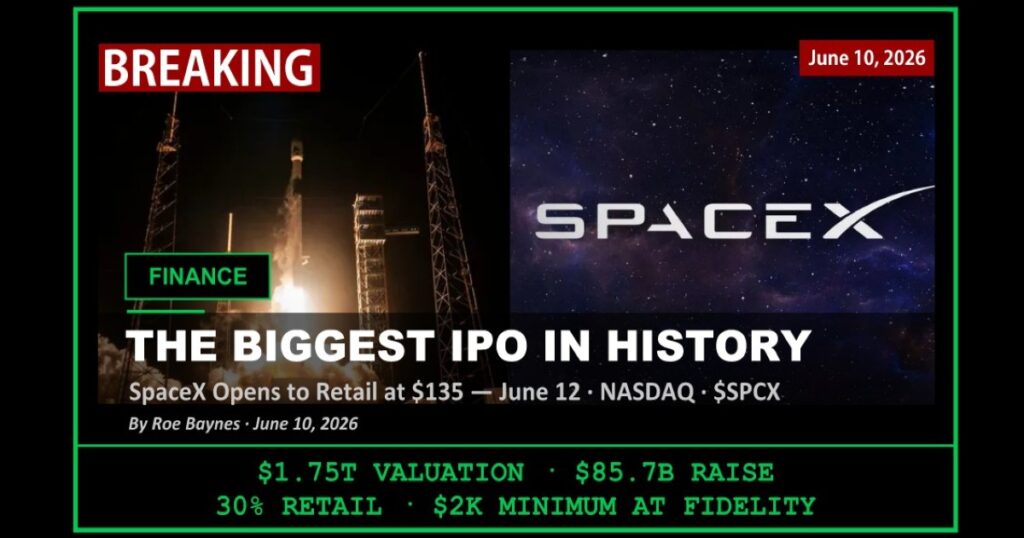
In two days the largest initial public offering in human history begins trading. SpaceX — Elon Musk’s combined rocket, satellite internet, and artificial intelligence empire — will debut on the Nasdaq under ticker SPCX on Thursday, June 12 at an offer price of $135 per share, targeting a market capitalization of approximately $1.75 trillion. The company plans to raise up to $85.7 billion, dwarfing every prior IPO in market history.
But the most disruptive element of this offering is not the size. It is who is getting to buy in.
The Numbers
The mechanics of the SpaceX IPO break almost every Wall Street tradition:
- Offering price: $135 per share — take it or leave it. Unlike traditional IPOs that publish a price range and then set the final number based on institutional demand, SpaceX is offering a single fixed price.
- Shares offered: Approximately 555.6 million shares
- Target raise: $74.4 billion, up to $85.7 billion if underwriters exercise their option
- Valuation at debut: Approximately $1.75 trillion — the largest valuation ever assigned to a privately-held company transitioning to public markets
- Listing: Nasdaq under ticker SPCX
- Trading begins: June 12, 2026
- Pre-IPO investor demand: Approximately $150 billion — double the $75 billion fundraising target, suggesting the offering is significantly oversubscribed
The banking syndicate behind the offering is unprecedented. The deal — internally code-named “Project Apex” — is being managed by 21 financial institutions led by Morgan Stanley, Goldman Sachs, JPMorgan Chase, Bank of America, and Citigroup.
The 30% Retail Allocation Mandate
The single most significant element of this offering is what Elon Musk personally mandated for retail investors.
A typical IPO reserves between 5% and 10% of shares for retail brokerage clients. The vast majority of shares go to institutional buyers — hedge funds, pension funds, mutual funds, and high-net-worth private clients. Average retail investors are usually limited to buying shares only after the stock has begun trading on the open market, often at significantly higher prices than the IPO offer price.
Musk overrode that convention. SpaceX has reserved up to 30% of the offering — approximately $22.5 billion worth of shares — for retail investors. SpaceX CFO Bret Johnsen called this “the largest retail participation in IPO history.”
This is structurally different from every major IPO that has come before it. And major brokerages have responded by dramatically lowering the barriers to entry.
Fidelity, Robinhood, and the Race to the Bottom on Account Minimums
The largest brokerages in America have moved fast to give retail clients access to SPCX shares:
Fidelity has lowered its IPO eligibility threshold from as high as $500,000 down to just $2,000 in account assets. Fidelity stated the change directly: “SpaceX has decided to reserve a much higher percentage of the offering (up to 30%), which means there should be more shares available to retail clients, which is why we have decided to reduce IPO eligibility for this offering.” That 99.6% reduction in the entry barrier is the most aggressive shift any major brokerage has made for any IPO in recent memory.
Robinhood, SoFi, Charles Schwab, and Morgan Stanley’s E*Trade are all participating with similarly low minimums — generally $2,000 or less.
The mechanics work like this: any client with $2,000 or more in eligible assets at a participating brokerage can submit an “indication of interest” specifying how many shares they want to purchase at the $135 offer price. After the book closes on June 11, the brokerage allocates available shares to participating clients — often pro rata across all interested investors when demand exceeds supply.
For ordinary American investors this represents the most accessible major IPO in modern history. A retail trader with $2,000 in a Fidelity account can submit an order to participate in what may become the largest IPO ever.
Is This Exit Liquidity for Early Investors?
Here is where the speculation gets interesting. Multiple market analysts have raised the question whether SpaceX’s unprecedented 30% retail allocation is fundamentally an exit strategy for early investors and employees rather than primarily a capital raise. Early investors who put money in at $40 a share through the secondary market and earlier insiders who hold stock from much lower entry points stand to realize enormous gains at the $135 IPO price. Polymarket estimates the offering will create approximately 4,000 new millionaires ranging from senior executives down to engineers and cafeteria workers.
By dedicating 30% of the offering to retail demand, SpaceX significantly accelerates the pipeline for early holders to convert their positions into liquid capital — sold not only to large institutional buyers but to millions of small retail accounts each absorbing a few hundred or few thousand dollars worth. This is not necessarily a bad thing for retail investors — SpaceX is genuinely one of the most valuable companies on Earth with $18.67 billion in 2025 revenue. But the structural question of who benefits most from this allocation pattern is worth understanding. Retail investors are providing the demand that allows early stakeholders to cash out at $135 a share. Whether that price holds, rises, or falls over the next year will determine whether retail was the smart money or the exit window.
The Tesla Merger Speculation
The other major speculation now circulating is whether the SpaceX IPO is a precursor to a Tesla-SpaceX merger. Musk now controls Tesla — itself a roughly $1 trillion company — and is about to control a newly public SpaceX worth $1.75 trillion. Both companies share overlapping interests in artificial intelligence (after SpaceX’s February 2026 acquisition of xAI), autonomy, energy systems, and manufacturing scale. Both also share what is arguably the most loyal retail investor base in modern public markets.
A stock-for-stock merger of the two would create the single largest publicly traded company in human history — roughly $2.75 trillion in combined market cap, ahead of Apple, Microsoft, Nvidia, and Saudi Aramco. The financial machinery to make this happen becomes available the moment SPCX begins trading. Musk has not announced anything. But the speculation alone is contributing to significant market dynamics this week.
Is the Market Crashing Because of SpaceX?
This is one of the most discussed dynamics across financial Twitter this week. The broader market has experienced notable selling pressure in recent trading sessions — and a credible theory is that institutional and retail investors alike are liquidating other holdings to free up cash for the SpaceX offering. SpaceX is asking the market to absorb up to $85.7 billion in new equity in a single offering, with pre-IPO indications of interest reaching $150 billion. That capital has to come from somewhere. How much of this week’s market weakness is attributable to SpaceX-related repositioning versus other factors like Federal Reserve policy expectations or geopolitical concerns remains debated — but the timing is suggestive enough that multiple market commentators have specifically named the SpaceX IPO as a contributing factor.
What Retail Investors Should Know Before Participating
A few practical considerations for anyone considering submitting an indication of interest before the book closes:
Lockup and flipping restrictions. Most participating brokerages impose restrictions on selling SPCX shares within the first 15 to 30 days. Fidelity allows free selling from the 16th day onward — the shortest lockup window of the group. Robinhood treats any sale within 30 days as flipping and bans the offender from IPO Access for 60 days across every future deal on the platform. SoFi uses a 180-day, then 365-day, then permanent ban structure for early sellers. Charles Schwab restrictions are offering-specific. E*Trade may flag accounts for future IPO exclusion.
Allocation is not guaranteed. Submitting an indication of interest does not guarantee you will receive shares. When demand exceeds supply — which is virtually certain given the $150 billion in pre-IPO interest against an $85 billion offering — brokerages allocate shares pro rata. You may receive substantially fewer shares than you requested or none at all.
The fixed $135 price. Because SpaceX is offering a take-it-or-leave-it price rather than a price range, there is no “discount to IPO” if institutional demand is weaker than expected. You are paying $135 or you are not buying.
The low public float. SpaceX’s IPO will result in only about 3% to 7% of total company shares being publicly traded. This unusually low public float means SPCX shares may experience significant price volatility once trading begins, as relatively small amounts of buying or selling pressure can move the stock price significantly.
Nasdaq fast-track inclusion. Nasdaq has implemented a special “fast-track inclusion” rule specifically for SpaceX that reduces the post-listing waiting period for index inclusion from three months to just 15 trading days. This means SPCX will likely enter the Nasdaq 100 index within weeks of its debut, triggering mechanical passive inflows from index funds and ETFs that mirror the Nasdaq 100. That demand could provide a strong tailwind for the stock in its first month of trading.
(Disclosure: The author has submitted an indication of interest for 20 shares at a $162 max price through Robinhood. See full disclosure policy.)
A Broader Context Note
The SpaceX IPO arrives the same week the SEC officially eliminated the $25,000 minimum equity requirement for pattern day traders — dropping that threshold to just $2,000 effective June 4, 2026. Combined with SpaceX’s unprecedented 30% retail allocation and Fidelity dropping its IPO eligibility from $500,000 to $2,000, this week represents arguably the most significant expansion of retail investor access to American capital markets in two decades.
We will be covering the PDT rule change in a separate detailed article later this week. For now the bottom line is this: more Americans have access to active trading and major IPO participation than at any point in the past 25 years.
Watch June 12 closely. It is the biggest IPO ever, the most retail-friendly IPO ever, and a potential preview of how every major IPO going forward will be structured.
Author Disclosure: The author has submitted an indication of interest to purchase 20 shares of SpaceX (SPCX) at a maximum share price of $162 through Robinhood as part of the June 12 IPO. Final allocation is not guaranteed and may be reduced or denied based on demand. This position should be considered in evaluating any opinions expressed in this article. Baynesworld.com does not hold institutional positions in any securities mentioned. Read our full Disclosure Policy at baynesworld.com/disclosure-policy.