
For full background on this story read our original coverage here → FREE CUBA: Raúl Castro Indicted
BREAKING — Published May 20, 2026 · By Roe Baynes · 6 Min Read
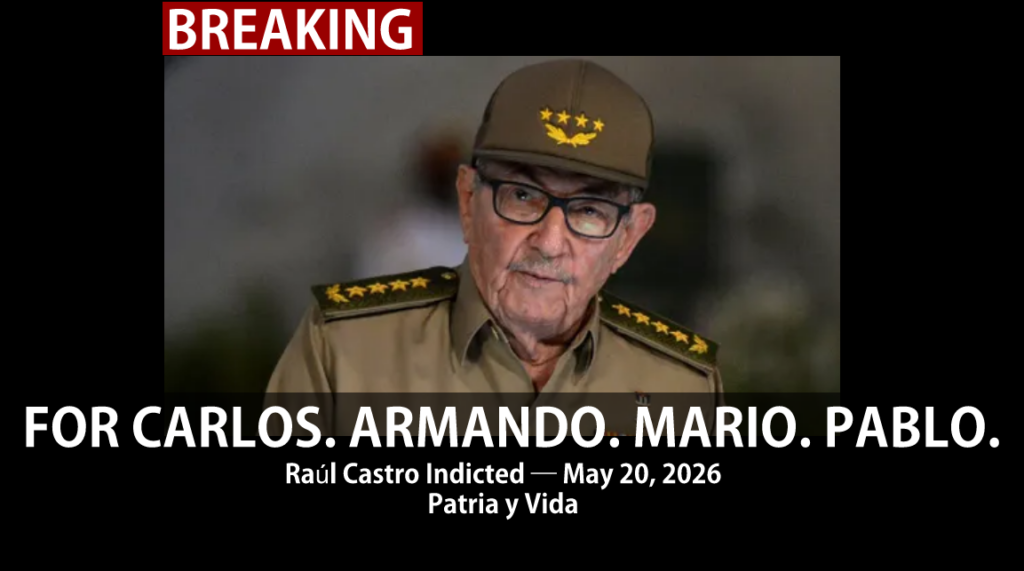
Today is Cuban Independence Day. And for the Cuban exile community in Miami — a community that has waited 30 years, mourned four murdered men, and never stopped demanding accountability — today finally delivered something that decades of diplomacy, politics, and bureaucratic cowardice could not: justice. Justice for Carlos, Armando, Mario, & Pablo. Brothers to the Rescue.
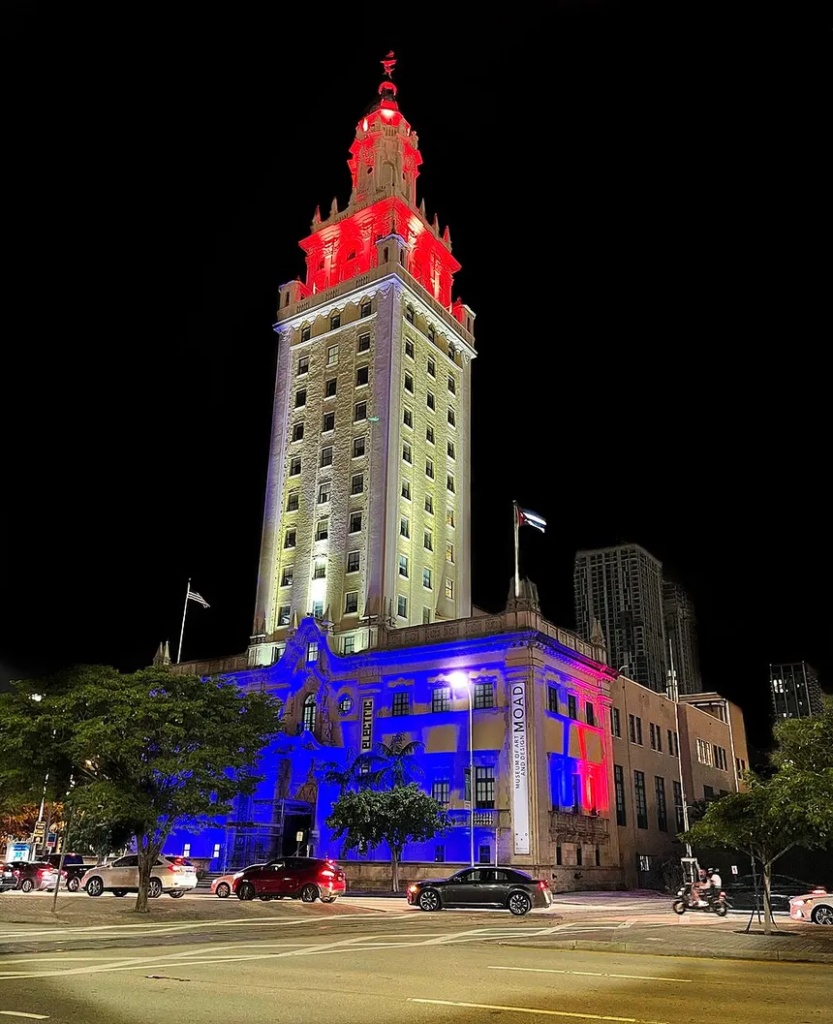
The Justice Department announced Wednesday that it indicted former Cuban President Raúl Castro on seven criminal charges, including murder and conspiracy to kill Americans. Acting Attorney General Todd Blanche made the announcement at a news conference in Miami, charging Castro on one count of conspiracy to kill U.S. nationals, four counts of murder, and two counts of destruction of aircraft. The announcement was made at Miami’s Freedom Tower — the building that for decades served as a processing center for Cuban refugees fleeing the very regime Castro helped build and maintain — a location chosen deliberately, on a day chosen deliberately.
The Charges — What He Is Actually Accused Of
The charges add Castro and five co-defendants — Lorenzo Alberto Perez-Perez, Emilio José Palacio Blanco, José Fidel Gual Barzaga, Raul Simanca Cardenas and Luis Raul Gonzalez-Pardo Rodriguez — to an existing criminal case stemming from the 1996 attack. That case, which was brought against three Cuban military officials, has been dormant since it was filed in 2003. The Cuban officials were never extradited to the U.S. to face criminal charges.
The indictment also alleges that Cuba’s intelligence agency tasked a network of spies in Florida with informing on Brothers to the Rescue. Jose Basulto, founder of Brothers to the Rescue, told CBS News Miami the organization had been completely penetrated by Cuban intelligence agents before the attack. In other words — Castro did not just order the shootdown. He had his spies inside the organization feeding him information about its operations before the missiles were ever fired.
The Justice Department’s criminal charges against former Cuban president Raúl Castro represent a prosecution more than 30 years in the works, with federal prosecutors in Miami first drafting an indictment against him in the 1990s. The original draft indictment was built on the momentum of the successful prosecution of Manuel Noriega, the Panamanian leader convicted in 1992 of racketeering and drug trafficking. “On the heels of the Noriega case, we frankly redoubled the efforts to move this case forward,” said Guy Lewis, a former U.S. Attorney in Miami. But the Clinton administration’s DOJ never approved it. Years passed. Administrations came and went. The families waited.
“He Can Be Brought In On a Stretcher”
The mother of one of the pilots killed in the 1996 shootdown told CNN she welcomes the news that former Cuban President Raúl Castro faces criminal charges for his alleged role in the attack. “[His age] doesn’t matter, he can be brought in on a stretcher,” said Miriam de la Peña, mother of Mario de la Peña, one of the four men killed when his Cessna was destroyed by a Cuban MiG-29 heat-seeking missile in international airspace on February 24, 1996.
Mario de la Peña was 24 years old when he was killed. His mother has spent the 30 years since his death fighting for this moment — attending rallies, meeting with lawmakers, refusing to let the world forget what the Castro regime did to her son and to three other Americans over the Florida Straits. Her words today — blunt, unbowed, and delivered with the quiet fury of a mother who has been waiting three decades — captured everything.
Miami Erupts
Crowds gathered outside Miami’s Freedom Tower and at Versailles Restaurant on Wednesday as members of South Florida’s Cuban exile community reacted emotionally to the federal indictment. Versailles — the legendary Cuban restaurant on Calle Ocho that has served as the unofficial meeting ground for the Miami Cuban community through every major moment of the past half century — was packed. One woman told CBS Miami: “Finally, after 67 years,” referencing 1959, the year the Castro brothers took power in Cuba. “Those beautiful young men and a resident were shot by the order of Raúl Castro.”
Hialeah Mayor Bryan Calvo said the announcement “speaks directly to a deep wound in our community.” “If this moment is going to mean anything, it has to be understood as more than a legal move against Raúl Castro. The problem goes further than one individual. The problem is an entire structure of power in Cuba that has ruled through fear, censorship, and violence for more than six decades. As long as that structure remains in place, there will be no real justice for Brothers to the Rescue and no real freedom for the Cuban people,” Calvo said.
Miami-Dade County Mayor Daniella Levine Cava said she stood with the families of the victims and called them heroes. “They flew unarmed, over open water, searching for Cuban refugees clinging to makeshift rafts in the Florida Straits — men, women, and children risking their lives for the chance at freedom,” she said.
Florida Congressman Mario Díaz-Balart called the shootdown “a deliberate act of murder” and said Castro needed to be held accountable. “Today marks the beginning of that long-denied path toward justice, made possible by the decisive actions of President Trump and the resolve of Acting Attorney General Todd Blanche.”
Florida Congressman Carlos Giménez — the only current member of Congress born in Cuba — said the indictment gives the United States the legal framework it needs to pursue broader accountability from the regime.
What Blanche and the DOJ Said
“For nearly 30 years, the families of four murdered Americans have waited for justice,” Acting Attorney General Todd Blanche said at the news conference. “My message today is clear: The United States and President Trump does not and will not forget its citizens.”
FBI Director Kash Patel added: “For 30 years these families have waited for answers — and the FBI never forgot. We will continue working with our Justice Department partners to bring to justice those who attacked our civilians.”
U.S. Attorney Jason Reding Quiñones was equally direct: “For 30 years, the families of these men have waited. The Miami community has waited. Our country has waited. Today is a step toward accountability. This passage of time does not erase murder. It does not diminish the value of these lives.”
When asked whether other members of the Castro regime will face additional charges, Blanche said: “This is an indictment, in some ways, 30 years in the making. Whether there will be additional charges, whether additional defendants are charged — who knows. But investigations like this are never over.”
Trump Responds: “We’re Freeing Up Cuba”
President Trump wasted no time making his position clear. Speaking to reporters on the tarmac after flying back from Connecticut, Trump called it “a very big day, very important day” for Cubans — both on the island and in the United States.
“It was a very big moment for people that, not only Cuban Americans, but people that came from Cuba that want to go back to Cuba, people that want to see their family in Cuba,” Trump said. “I have so many Cuban friends in Miami, mostly in Miami and Florida, and they’re unbelievable people. They’re unbelievable entrepreneurs, and they’d like to go back.”
Then came the statement that sent shockwaves through Havana: “We have a lot of people in Cuba. We have the CIA there. Secretary of State Marco Rubio is from there, so we have a lot of expertise. We’re going to help the Cuban people out. We’re freeing up Cuba.”
Trump also said the U.S. will make an announcement on the embargo against Cuba “pretty soon” — and the U.S. military simultaneously announced the arrival of the Nimitz Carrier Strike Group in the Caribbean. Secretary of State Marco Rubio addressed the Cuban people directly in a Spanish-language video, telling them that “the only thing standing in the way of a better future are those who control your country.”
Trump said “Cuba is a failed nation” and added “There won’t be escalation. I don’t think there needs to be.” He declined to comment on whether the U.S. military would move to capture Castro as it did with Venezuelan President Nicolás Maduro in January. He did not need to say it out loud — the Nimitz Carrier Strike Group now sailing in the Caribbean said it for him. Trump has also raised the possibility of a “friendly takeover” of Cuba, saying of the island’s leadership: “They want to make a deal so bad.” Whether that deal comes before or after further pressure — legal, economic, or military — is the question the entire Western Hemisphere is now watching.
Cuba’s current president Miguel Díaz-Canel fired back immediately, calling the indictment a political maneuver with no legal foundation and accusing the U.S. of fabricating a pretext for military aggression. The regime’s response was defiant — but notably thin on substance, and notably absent of the confidence that comes with having a powerful ally at your back. Venezuela’s Maduro is gone. The oil has stopped flowing. The lights are out across the island for 20 hours a day. And now the man who ordered four Americans murdered in international airspace has been charged with their deaths by a federal grand jury in Miami.
The walls are closing in. And this time Washington is not looking away.
A Personal Note
I have written in previous pieces about being the American-born son of two Cuban immigrants, married to a Cuban immigrant. Today is a day I have to address directly and personally.
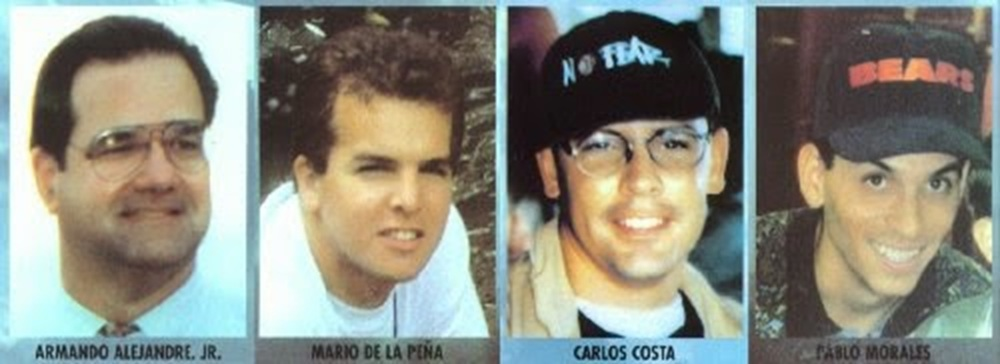
I grew up hearing about Brothers to the Rescue. I grew up knowing the names Carlos Costa, Armando Alejandre Jr., Mario de la Peña, and Pablo Morales — four men who died doing something selfless, humane, and brave. They were not soldiers. They were not combatants. They were flying unarmed civilian planes over international waters looking for Cuban rafters — people just like my parents’ generation — desperate men and women and children clinging to inner tubes in shark-infested waters for a chance at the freedom that the Castro regime had stolen from them.
Raúl Castro ordered those planes destroyed. He ordered four men killed in cold blood in international airspace. And for 30 years — through Democratic and Republican administrations alike — he faced no consequences. The families mourned. The community remembered. And the United States government, time and again, decided that diplomatic convenience was more important than justice.
Not today.
Whatever happens next — whether Castro is ever physically brought to trial, whether he dies at 94 before a verdict is rendered, whether this indictment leads to broader action against the regime — today mattered. The mother of Mario de la Peña said it best: his age doesn’t matter. He can be brought in on a stretcher. After 30 years of waiting, Miriam de la Peña is not interested in excuses. Neither is Miami. Neither am I.
Patria y Vida. For Carlos. Armando. Mario. Pablo. Los Hermanos al Rescate CUBA LIBRE!
For full background on the Brothers to the Rescue shootdown, the CIA meeting with Raúl Castro’s grandson, and the broader Cuba story read our original coverage: FREE CUBA: Raúl Castro Indicted